

A bi-weekly look at the trends driving economies and investments worldwide.


Economic Landscape: Persistent fiscal pressures, shifting trade patterns and rising defense commitments provide a complex backdrop for the incoming Congress. Meanwhile, technology investment has become an increasingly important driver of U.S. growth, although its precise contribution remains sensitive to measurement assumptions.
Political and Policy Outlook: The Democratic takeover of Congress could reshape priorities surrounding trade, defense, healthcare and technology regulation. However, presidential authority, competing fiscal priorities and legislative gridlock may limit the extent of policy changes, against a backdrop of subdued and uneven economic sentiment.
Financial Market Implications: The initial post-midterm market reaction highlights shifting investor expectations, while elevated Treasury yields and a positive term premium suggest continued sensitivity to inflation and fiscal uncertainty. Historical equity performance across political configurations offers useful perspective, although economic fundamentals may ultimately matter more than political control.
Insights
U.S. federal finances remain under considerable pressure, with persistent deficits and rising debt-servicing costs increasingly limiting fiscal flexibility. Federal expenditure continues to exceed revenues by a substantial margin, while net interest payments absorb approximately one-fifth of federal receipts. The incoming Democratic-controlled Congress may challenge some of the administration's fiscal priorities while pursuing additional spending on healthcare and other domestic initiatives. Potential compromises over defense expenditure and taxation could also affect borrowing requirements. However, structural spending commitments and disagreements over government funding suggest that the midterm outcome alone may do little to improve the fiscal trajectory.

Insights
U.S. import patterns have undergone considerable changes since the introduction of the Liberation Day tariffs in April 2025. China has recorded substantial declines across several selected industries, contrasting with increases from other Asian trading partners, particularly in technology-related categories. These developments may reflect supply-chain diversification, although AI-related demand, changes in sourcing arrangements and trade timing could also explain some of the movements. The Democratic takeover of Congress may increase scrutiny of existing tariffs, potentially with support from some Republican lawmakers. Nevertheless, presidential authority over trade policy could limit the scope for immediate changes, leaving future trade patterns dependent on political negotiations and corporate sourcing decisions.

Insights
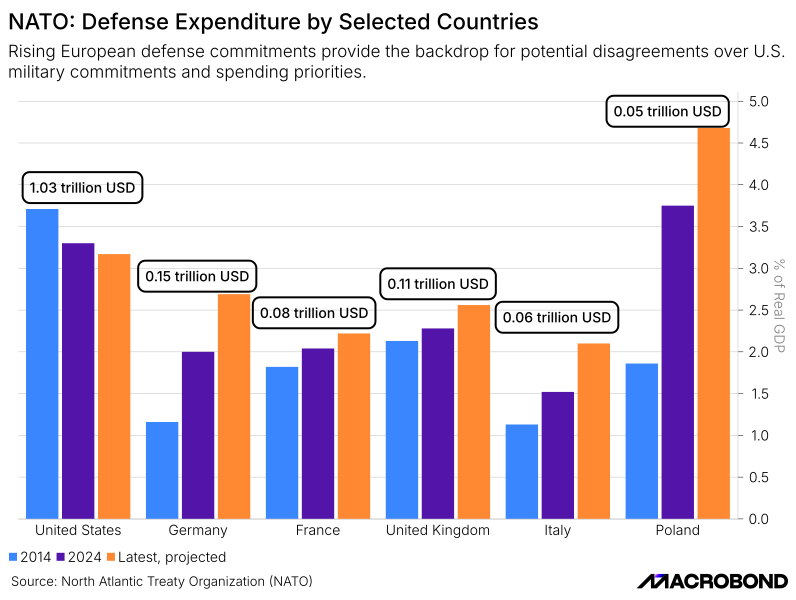
NATO's renewed defense commitments, most notably the agreement reached at the June 2025 Hague Summit, reflect efforts to strengthen collective defense, improve military readiness and establish a more balanced sharing of responsibilities between the United States and its allies - partly in response to concerns over Russia's military activities and the broader European security environment. The U.S. midterm results may introduce competing priorities, with a Democratic-controlled Congress potentially seeking greater support for Ukraine and a tougher stance toward Russia, while challenging continued military involvement in Iran. Strategic competition with China could remain an area of bipartisan cooperation. Presidential authority and congressional control over appropriations may nevertheless complicate decisions over the scale and geographical allocation of future defense expenditure.
Insights
Technology-related investment has become an increasingly important contributor to U.S. economic growth, with computers, software and data centers accounting for approximately 41% of annual GDP growth in the third quarter of 2026, despite representing only around 4.3% of nominal GDP. The divergence illustrates how rapid investment growth can generate substantial economic contributions even from relatively small expenditure categories. The midterm results could introduce additional scrutiny of AI infrastructure, particularly regarding electricity costs, data-center development and regulatory requirements. While these developments may affect investment momentum, continued demand for computing capacity could support expansion, leaving the broader growth implications dependent on how policy changes influence future capital expenditure.

Insights
While technology investment has become a significant driver of U.S. economic growth, isolating AI's precise contribution remains challenging. Six methodological dimensions illustrate this uncertainty: direct technology investment, broader equipment and R&D definitions, adjustments for imported technology, consumption growth relative to disposable income, alternative wage-based benchmarks and partial attribution of investment specifically to AI. Depending on the assumptions, estimated contributions range from 8% to more than 100% of annual GDP growth. The divergence highlights how measurement choices can fundamentally change assessments of technology's economic significance. These scenarios represent alternative accounting approximations rather than established causal effects, an important distinction as policymakers consider potential restrictions on AI-related investment.

Insights
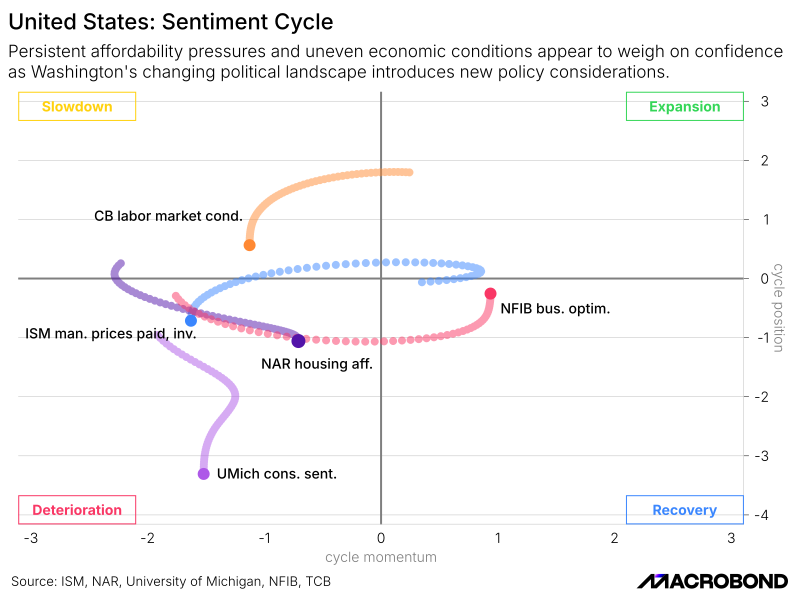
Economic sentiment has remained subdued despite relatively resilient U.S. growth, suggesting a disconnect between headline economic performance and household experiences. Three factors may help explain this divergence: uneven developments in spending power and financial wealth, often described as a K-shaped economy; persistent affordability pressures; and uncertainty surrounding employment, trade policy and business conditions. The cyclical indicators appear consistent with these tensions, particularly the weakness in consumer confidence and housing affordability relative to business sentiment. The midterm results could alter expectations through renewed attention to household affordability, healthcare and fiscal priorities. However, political disagreements may offset some potential benefits, while early post-election surveys suggest that confidence could shift between different segments of the economy rather than improve uniformly.
Insights
Financial markets reacted sharply to the U.S. midterm results, with an initial equity rally giving way to a broader reassessment of political, economic and corporate risks. The S&P 500 declined 4.4% on November 5, while deteriorating momentum, market breadth and increased volatility contributed to weaker investor sentiment. Although technology-related equities experienced pronounced losses, the reaction extended across asset classes and sectors. Changing expectations surrounding the U.S.–Iran conflict influenced energy and Treasury markets, while investors reassessed prospects for defense, healthcare and tariff-sensitive industries. These movements suggest that investors were responding to competing expectations about future policy rather than changes already enacted. Whether the initial volatility develops into a more persistent deterioration in sentiment may depend on inflation, monetary policy, corporate earnings and the direction of future policy negotiations.

Insights
Beyond the immediate market reaction to the midterms, U.S. Treasury yields reflect a broader combination of monetary policy expectations, inflation risks and fiscal pressures. Much of the increase from pandemic-era lows appears associated with higher real yields, while the ACM term premium has also returned to positive territory, potentially reflecting greater sensitivity to interest-rate uncertainty, Treasury issuance and longer-term fiscal risks.
The incoming Democratic-controlled Congress could introduce competing influences through negotiations over taxation, expenditure and government funding. Some of the administration's fiscal priorities may face greater scrutiny, while potential compromises involving healthcare, defense and other domestic programs could maintain or increase borrowing requirements. Meanwhile, disagreements over the debt ceiling and budget priorities may add to investor uncertainty. With structural deficits and debt-servicing costs already elevated, the outlook for long-term yields may depend as much on Federal Reserve policy and inflation developments as on whether the changing political landscape materially alters Washington's fiscal trajectory.

Insights
Historical Dow Jones Industrial Average performance appears to vary considerably across configurations of presidential and congressional control. Periods with a Republican president and Democratic Congress have generally coincided with relatively elevated volatility and subdued returns, although these observations also encompass major disruptions, including the 1987 market crash and the global financial crisis. The incoming Democratic-controlled Congress could limit certain legislative initiatives, while disagreements over fiscal priorities, regulation and executive authority may prolong uncertainty. Historical experience nevertheless offers little evidence of a consistent relationship between political gridlock and equity performance. Ultimately, market outcomes may depend more on other prevailing economic and financial factors than on Washington's political configuration itself.


