A bi-weekly look at the trends driving economies and investments worldwide.


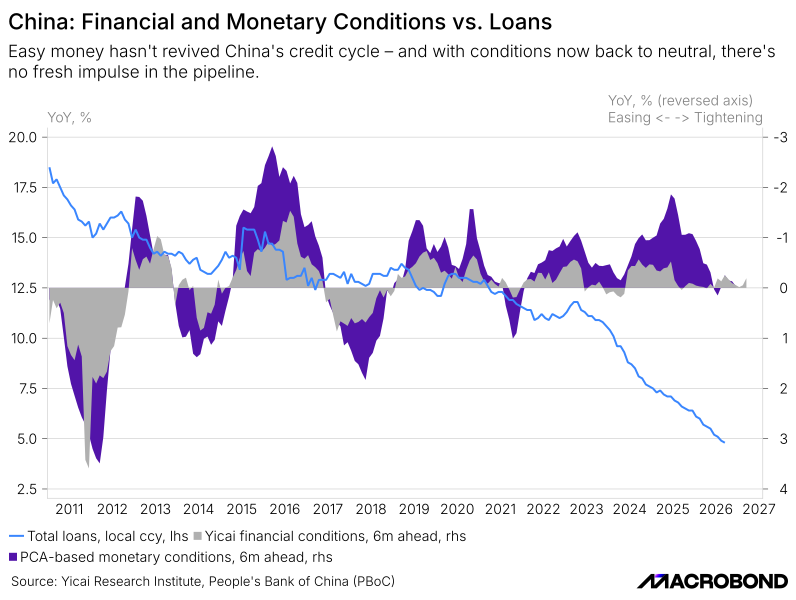
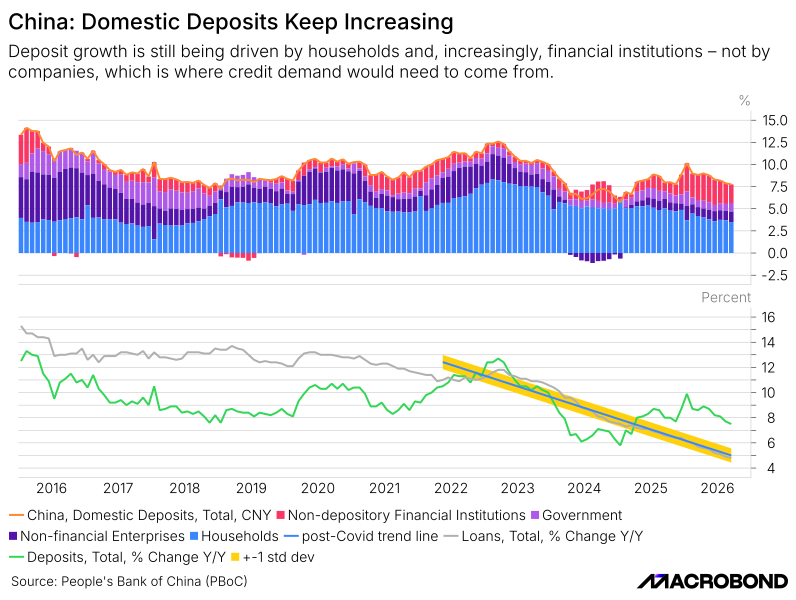
Households are saving, not spending. Deposit growth has outpaced loan growth for two years, loan growth has slid to around 5% along a steady post-COVID downtrend, and monetary conditions that sat in easing territory through 2024–25 failed to revive borrowing – the constraint is demand, not credit supply.
The young generation is both smaller and under pressure. Youth unemployment is at a record under the redefined series just as the shrinking cohorts born in the late 1990s reach household-forming and home-buying age – a double hit to property demand that extends well beyond this cycle, while PBoC survey price expectations near cycle lows point to inflation plateauing near 1%.
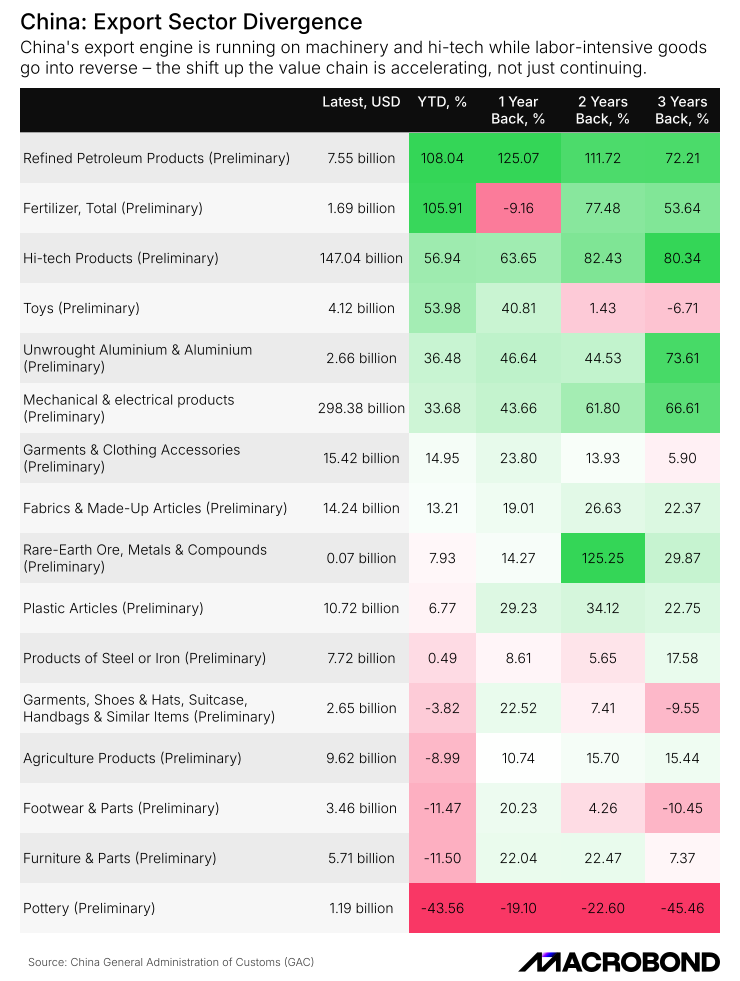
The economy is running at two speeds. Machinery and hi-tech exports are growing at double-digit rates while labor-intensive goods shrink, and producer prices are rising far faster than retail sales – a supply-driven reflation that squeezes downstream margins rather than signaling consumer recovery.
Insights
Lagging the birth rate by roughly a quarter-century lines it up with the age at which Chinese households typically form, buy a first home and hit peak productivity. The fit is loose – the 1982 baby-boom cohort coincided with the 2006–07 property and GDP surge, and the smaller late-1980s echo with the 2010–13 cycle – but the direction of the demographic tailwind-turned-headwind is unmistakable. Birth growth turned negative from the mid-1990s and fell further after 1999, which maps onto the 2020s: fewer first-time buyers, a smaller incoming workforce and weaker household formation precisely when the property sector is trying to find a floor. Because births kept declining through the 2000s and collapsed again after 2017, this drag is not a cycle that reverses in a few years but a structural slope that runs well into the 2030s.

Insights
China's youth unemployment rate follows a predictable seasonal pattern – a dip in spring, a surge in July–August as new graduates enter the market, then a gradual decline into year-end – but the whole curve keeps shifting higher. September's 18% reading sits above the same month in both 2024 and 2025, and matches the 2022 level, which is striking given that the 2022 series was compiled under the old methodology that included students and was discontinued after hitting a record 21.3% in mid-2023. On a like-for-like basis, 2026 is the worst year since the redefined series began. The more concerning detail is the pace of normalization: in 2024 the rate had dropped more than a point from its August peak by September, whereas this year it has barely moved, suggesting the summer cohort is being absorbed more slowly. With a record 12m-plus graduates competing for roles in a private sector still cautious on hiring, youth joblessness is a structural problem rather than a seasonal one – and a direct drag on the household confidence and consumption that Beijing is counting on.

Insights
Breaking total deposit growth into its components shows why China's savings glut is not translating into activity. Households have contributed a steady 4–5 percentage points throughout the post-COVID period, consistent with the precautionary saving seen elsewhere in the data. Non-financial enterprises, by contrast, have added almost nothing since 2023 and briefly subtracted from growth in 2024 – a sign that corporate cash flows are thin and firms are not accumulating the balances that normally precede capex and hiring. The notable change over the past year is the growing red segment: deposits at non-depository financial institutions, which picked up through 2025 and remain elevated. That looks like household money rotating out of plain bank deposits into wealth products, funds and brokerage accounts amid the equity rally – a reshuffling within the financial system rather than a release of savings into the real economy. With loan growth still tracking its post-COVID downtrend at around 5%, the deposit side confirms the picture: liquidity is abundant, but it is pooling with savers and asset managers rather than reaching borrowers.
Insights
The headline export numbers mask a sharp split beneath the surface. The two categories that matter most by value – mechanical and electrical products ($298bn) and hi-tech products ($147bn) – are posting year-to-date gains of 34% and 57%, extending three straight years of strong growth and confirming that China's competitiveness in machinery, EVs, batteries and electronics has not been blunted by tariffs. At the other end, the traditional labor-intensive exports that built China's trade surplus in the 2000s are shrinking: footwear and furniture are down more than 11%, garments and accessories are negative, and pottery has collapsed by over 40% for the second time in three years. The pattern reflects both deliberate industrial policy and external pressure – low-margin production is migrating to Vietnam, Bangladesh and elsewhere, partly in response to U.S. tariffs, while Chinese firms concentrate capital in higher-value segments. The surges in refined petroleum and fertilizer look more like price and quota effects than structural shifts. For trading partners, the implication is uncomfortable: China is becoming less of a competitor in cheap consumer goods and more of one in the advanced manufacturing that Europe and Japan have historically dominated.
Insights
The latest data show raw material producer prices rising 2.6% m/m against just 0.35% growth in retail sales – one of the widest gaps between upstream prices and end demand since the 2021 commodity surge. This matters for how to read China's apparent reflation: the price pressure is originating in inputs, likely reflecting anti-involution capacity cuts and commodity moves, rather than being pulled through by consumers. Unlike 2020–21, when retail sales were also rebounding sharply, households today are not providing the demand to absorb higher costs, so the burden falls on mid- and downstream manufacturers' margins.

Insights
The PBoC's urban depositor survey has historically been a useful early signal for Chinese inflation, with shifts in households' price expectations showing up in headline CPI roughly two quarters later – most clearly in the2010–11 inflation cycle and the subsequent downturn. That relationship has loosened since 2019, when a supply-driven pork price spike pushed CPI up with no corresponding move in expectations, but the broad direction still holds. The latest readings offer little encouragement for those hoping for a decisive end to China's disinflation: CPI has recovered from last year's negative prints to around 1%, yet household expectations remain near the bottom of their 15-year range and have only just stopped falling. Unless consumers start anticipating higher prices – which would require a firmer labor market and housing stabilization rather than supply-side quirks – the survey suggests inflation is more likely to plateau at low levels than build on its recent rebound.

Insights
For most of the past decade, shifts in China's financial and monetary conditions were a reliable six-month lead on credit growth: easing episodes in 2012–13, 2015–16 and 2019 were each followed by a pickup in loan growth, while tightening phases saw it slow. That relationship has broken down since 2022. Both the Yicai financial conditions index and our PCA-based measure of policy instruments sat firmly in easing territory through 2024 and 2025 – the deepest easing since the post-GFC period – yet total loan growth kept decelerating, falling to around 5% YoY, the weakest on record. This is the signature of a demand-side problem: lower rates and ample liquidity cannot force households and firms to borrow when property is still deleveraging and confidence is weak. More worrying, both conditions indices have now drifted back to neutral, which means the forward-looking impulse from policy has faded just as credit growth hits new lows. Absent a renewed easing push – or fiscal measures that create borrowers rather than just cheaper loans – the chart offers little basis for expecting a near-term credit recovery.