A bi-weekly look at the trends driving economies and investments worldwide.


Insights
Current market discussion increasingly centers on whether curve dynamics reflect a market already priced for limited additional easing, with front-end yields anchored by expectations of only modest further rate cuts. Conversely, some investors point to structural forces — including elevated issuance and uncertain inflation persistence — that could keep long-term yields higher, a backdrop that tends to generate duration headwinds.
However, should growth expectations weaken, long-end yields may instead compress more meaningfully, and investors may increase duration exposure amid rising macro uncertainty.

Insights
Market discussion increasingly focuses on whether policy remains above neutral and how much further adjustment may be required. While markets currently price only a limited easing cycle for 2026, resilient activity and persistent inflation could delay cuts — or even reopen debate around additional tightening. In this environment, term-structure dynamics provide an important lens through which investors assess how rates markets reconcile competing macro signals.
Against this backdrop, deviations of Treasury yields from their Nelson–Siegel–Svensson fitted levels — illustrated here using the 10-year tenor — may highlight periods of rate dislocation that have occasionally coincided with tactical opportunities.

Insights
Following the Supreme Court ruling — and the executive response that followed — trade policy uncertainty has moved back into focus for markets. Although the macroeconomic implications remain unclear, past episodes suggest that elevated trade uncertainty can transmit into Treasury market sentiment.
Against a backdrop of heightened volatility, markets tend to simultaneously reprice growth prospects, inflation expectations, and the expected Fed policy path.

Insights
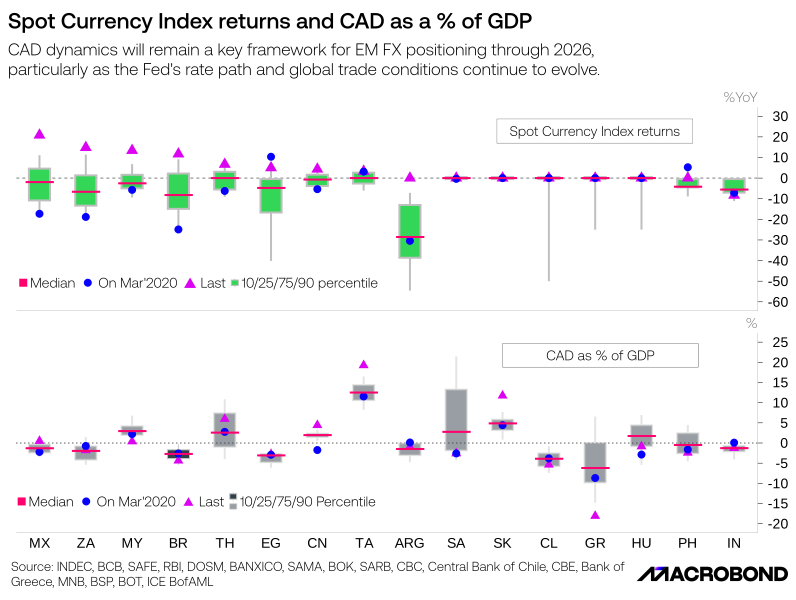
The interaction between Current Accountdynamics and Currency Spot index returns will remain a key framework for EM FX positioning through 2026, particularly as the Fed's rate path and global trade conditions continue to evolve.
Currencies with large current account surpluses typically outperform, while high-carry currencies face growing headwinds - a dynamic clearly visible in this chart, where surplus economies like Taiwan and Thailand sit in more stable spot-return territory, while deficit or structurally imbalanced economies like Argentina and Hungary show deeper depreciation ranges.
EM currencies have strengthened against the US dollar, driven in part by strong EM equity performance and a weaker dollar backdrop - though this optimism applies more selectively to economies with sound fundamentals than to the structurally challenged names.
Insights
Over the past six months, improvements in manufacturing activity have been concentrated in EMs, and sovereign credit default swap (CDS) spreads have broadly moved in sync with those upgrades -tightening where growth momentum has strengthened, and widening where it has faded.
The chart reflects a growing bifurcation within the DM and EM universe. Countries with improving manufacturing momentum- particularly across ASEAN and Northeast Asia - are seeing their credit risk repriced favorably, while developed market economies like Austria, Spain, and Ireland, alongside commodity-sensitive EMs like Thailand and Saudi Arabia, face the opposite trend. The IMF's Global Financial Stability Report has noted that increased local currency sovereign bond issuance and domestic absorption have supported emerging market resilience, though risks remain from heavy borrowing and overreliance on narrow investor bases.
Sovereign CDS markets appear to befunctioning as a real-time validation mechanism for the global PMI upgradecycle - and right now, that cycle is unmistakably an emerging market story, ledby Asia's export powerhouses riding the AI and semiconductor wave.

Insights
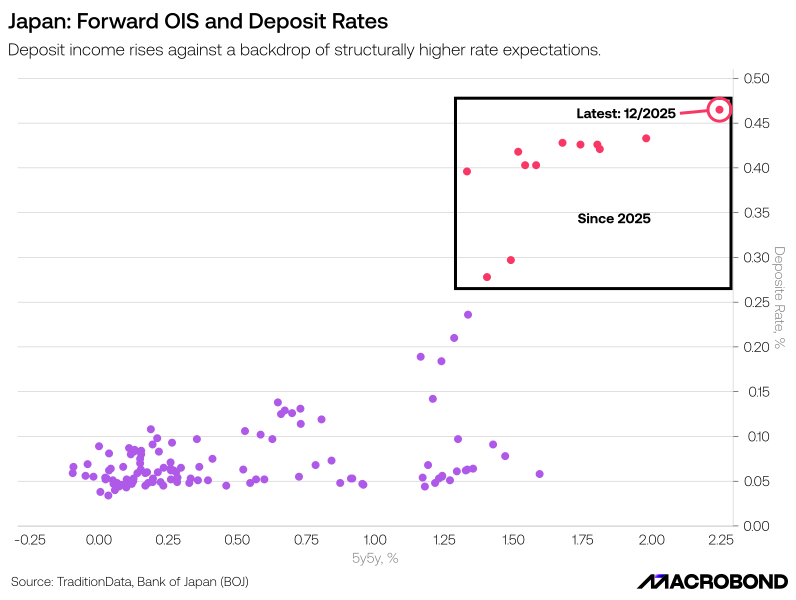
Japan has finally moved beyond its long-standing low-inflation, zero-rate environment, with market pricing and inflation expectations now broadlyanchored around the Bank of Japan’s 2% objective.
Against this backdrop, rising deposit rates suggest normalization is beginning to reach households, potentially increasing the likelihood of partial capital repatriation as domestic yields reduce the incentive to seek returns abroad.
Insights
More recently, UK inflation is steadily decelerating, while unemployment has edged higher, raising expectations of easing from the BoE - 50bps priced in for end 2026.
The green 2y10y spread clearly reflects monetary cycle dynamics. Through GFC and QE, the curve steepened - This gave bond investors a generous carry trade. As rates rose aggressively from 2022,the curve inverted as markets priced in front-loaded tightening.
The Long End: 10y30y : For much of the post-GFC period, 30-year yields compressed dramatically alongside 10-year yields as QE suppressed term premia across the curve. The 2022 mini-Budget and inflation concerns reversed this decisively. Higher term premia resulted from record government borrowing, the BoE's shift from QE to QT, and waning structural demand from UK DB pension funds.
For most of the post-2000 period, the all-maturities total return index delivered positive returns. Aggressive rate hikes and the LDI crisis had 2022 mark nearly -25% returns.
The partial recovery since then reflects the beginning of the easing cycle, though returns remain volatile.
Looking ahead, expectations remain for steepening of the UK yield curve with further policy easing implying lowershorter end. These expectations have supported positive returns in 2026.

Insights
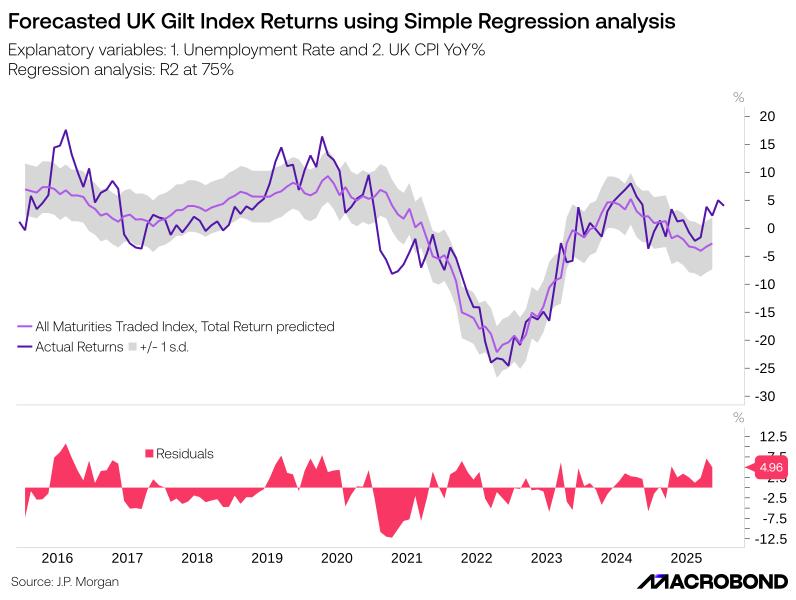
The All maturities Gilt Index returns is forecasted using a simple Regression analysis with two explanatory variables, viz. Inflation and Unemployment rate. The analysis estimates model R2 (~75%), tests for each individual variables explanatory power and predicts forecast variable basis the coefficients of the explanatory variables.
Insights
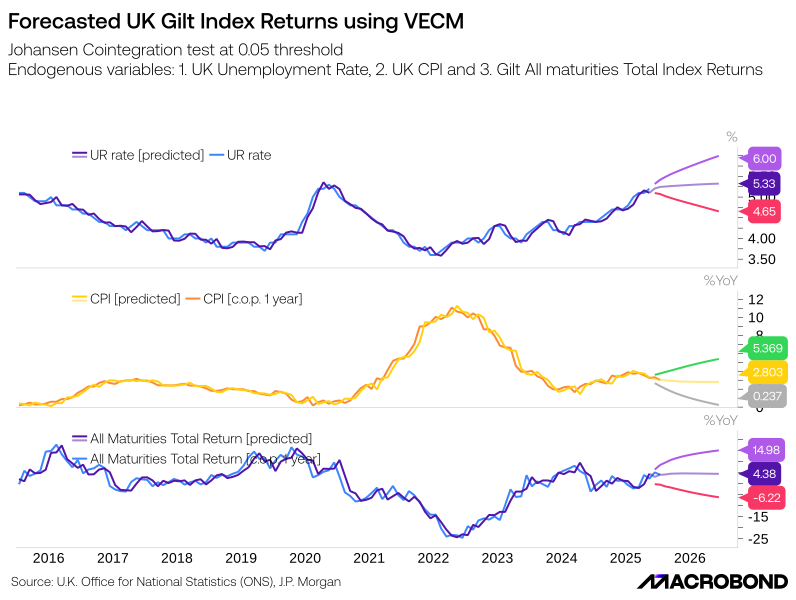
The All maturities Gilt Index returns is forecasted using a simplified VAR VECM model with two explanatory variables, viz. Inflation and Unemployment rate. The model tests for cointegration and predicts equations for each of the endogenous variables. Softening in inflation trends, rising unemployment rate can imply a steeper yield curve supporting positive Gilt returns.
Insights
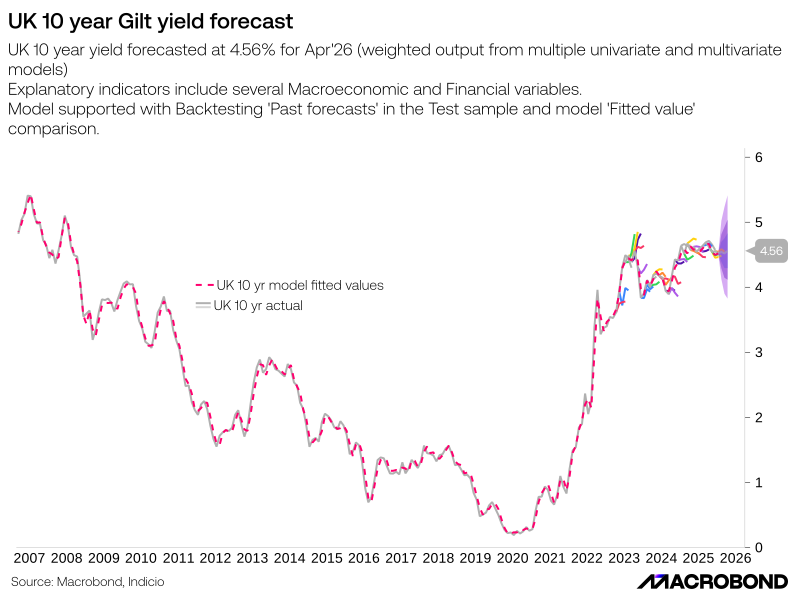
The UK 10 year yield for Apr'26 is forecasted at 4.56% as a weighted output from multiple univariate and multivariate models using Indicio. The forecast considers several macro economic and financial variables as explanatory indicators. The model has been backtested with 'Past forecasts' in the Test sample and a comparison is made with the model 'Fitted value’.
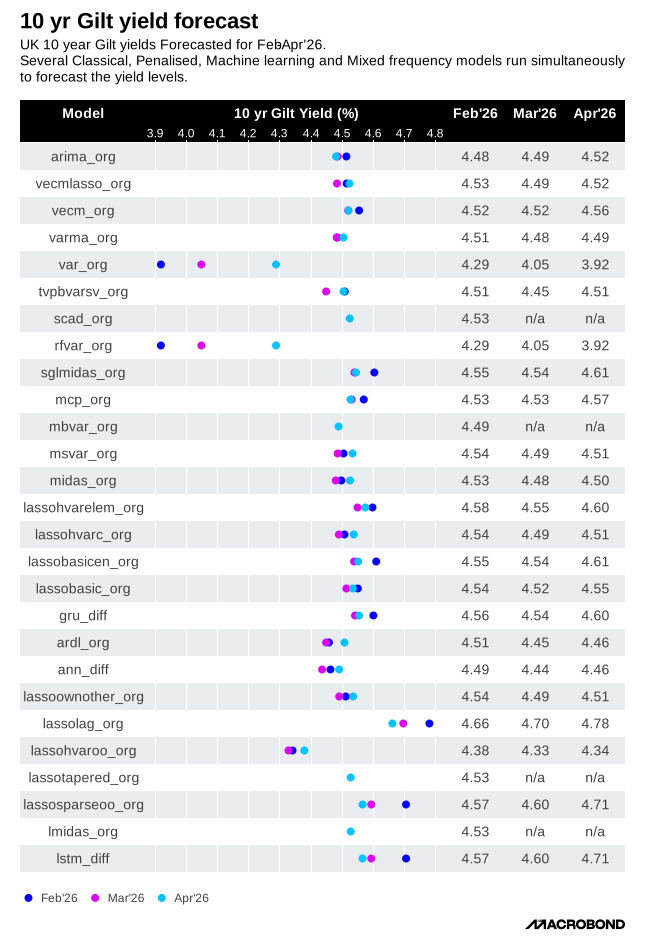
The table shows the forecasted values for UK 10 year yield for Feb-Apr'26. Several Classical, Penalised, Machine learning and Mixed frequency models run simultaneously to forecast the yield levels.