A bi-weekly look at the trends driving economies and investments worldwide.


Policy Constraint, Not Cycle: Despite the sharp repricing higher in implied paths, terminal rates remain below neutral, suggesting markets see limited scope for a sustained tightening cycle. The shock is being treated more as a near-term inflation disturbance than a regime shift in policy stance.
Asymmetric Transmission: The UK shows stronger rate sensitivity due to more direct energy pass-through into services and wages, while Switzerland remains insulated and Nordic responses diverge based on terms-of-trade effects. The shock is not uniform - it is filtered through each economy’s structure.
Demand Destruction: Rising inflation expectations are already weighing on consumer sentiment and discretionary spending, pointing to emerging demand erosion. This suggests the energy shock may ultimately tighten conditions via weaker growth rather than sustained inflation pressure.
Insights
Prior to the Iran conflict, markets were pricing a gradual easing cycle across both the ECB and BoE, with rates expected to decline into 2026–27. This has since reversed, with policy paths shifting higher and flattening at elevated levels, indicating a reassessment toward fewer cuts and a higher expected rate path.

Insights
Market pricing has undergone a sharp reversal, shifting from an easing bias—where cuts were expected—to a more hawkish path following the recent energy shock. Prior to the disruption, both ECB and BoE were largely seen on hold or gradually easing, with rate cuts priced over the coming year.
Since then, expectations have repriced rapidly toward multiple hikes, reflecting the inflationary impulse from higher energy prices. While some stabilisation has emerged more recently, the expected policy path remains materially tighter than pre-shock levels.

Insights
While markets are pricing the possibility of near-term hikes, the expected tightening cycle could prove limited in scope, given already elevated policy settings and a narrower gap to levels consistent with moderating demand and inflation.
Indeed, many investors tend to compare the current backdrop with 2022, but the configuration is somewhat different: policy then started from deeply accommodative levels and required a broad upward adjustment into restrictive territory, whereas the current repricing reflects a more contained adjustment from already elevated levels, reducing the need for a prolonged hiking cycle.

Insights
At the start of 2026, both Germany and the UK were in bull territory, with markets pricing continued disinflation and a gradual easing cycle, while Switzerland remained in bear territory given already low inflation and limited scope forcuts. On the onset of the Iran conflict, European term structures shifted into bear territory as energy-driven inflation risks triggered a sharp repricing higher in rates.
More recently, the UK appears to have softened, likely reflecting growing growth concerns that have tempered the initial repricing, while Germany and Switzerland remain in bear territory, suggesting a more cautious reassessment of inflation risks and limited conviction on easing.

Insights
Although central banks typically aim to look through energy shocks, market pricing suggests their reaction functions are not fully insulated. The Bank of England appears more sensitive than the ECB, reflecting stronger domestic inflation persistence and faster pass-through into services. Indeed, the current backdrop suggests the MPC is more alert to second-round effects, whereas the ECB remains more conditional on whether the shock feeds into wages and medium-term inflation.
Both, however, are priced to respond more than the SNB, where the inflation impact ofthe shock tends to be comparatively muted, limiting the need for policy adjustment. In the current setting, the SNB has emphasised that while energy may lift inflation in the near term, underlying pressures remain contained within its price stability range, reinforcing a more measured policy response.

Insights
Higher oil prices generally lift front-end yields across developed market Europe, reflecting repricing of policy expectations. Although Germany, France and the UK exhibit broadly similar directional responses, the UK tends to show a slightly larger reaction, reflecting greater domestic inflation persistence anda more direct pass-through of energy costs into household bills and services inflation.
Conversely, Switzerland typically displays the smallest response, predominantly due to its safe-haven status - corroborated by the current backdrop, where the SNB appears among the most neutral of major European central banks, relying less on rate adjustments in response to energy-driven inflation dynamics.
Interestingly, Norway tends to exhibit a stronger reaction than Sweden, as the shock is primarily macro-driven for the Norwegian economy - via improved terms of trade and stronger income dynamics - which supports a more hawkish policy bias. Sweden, by contrast, faces a more traditional imported inflation shock, where higher energy prices compress real incomes and weigh on domestic demand, limiting the extent of front-end repricing.

Insights
Energy shocks in CEE have historically led to persistent upward repricing in yields rather than quick reversals. This reflects the nature of large energy shocks, which extend beyond headline inflation and feed into wages, services, and broader price dynamics. Evidence from Europe shows that pass-through strengthens when shocks are large and persistent, particularly in tight labour markets, allowing inflation to become more entrenched.

Insights
Another consequence of rising energy costs is the squeeze on consumption patterns, with households across the euro area increasingly retrenching from discretionary spending and prioritising essentials. Both consumer and business surveys are already pointing to weakening demand - particularly in services - as higher price expectations feed into more cautious behaviour. This underscores the need to monitor demand destruction signals, which, if sustained, could gradually erode firms’ pricing power and temper underlying inflation dynamics beyond the immediate energy-driven shock.

Insights
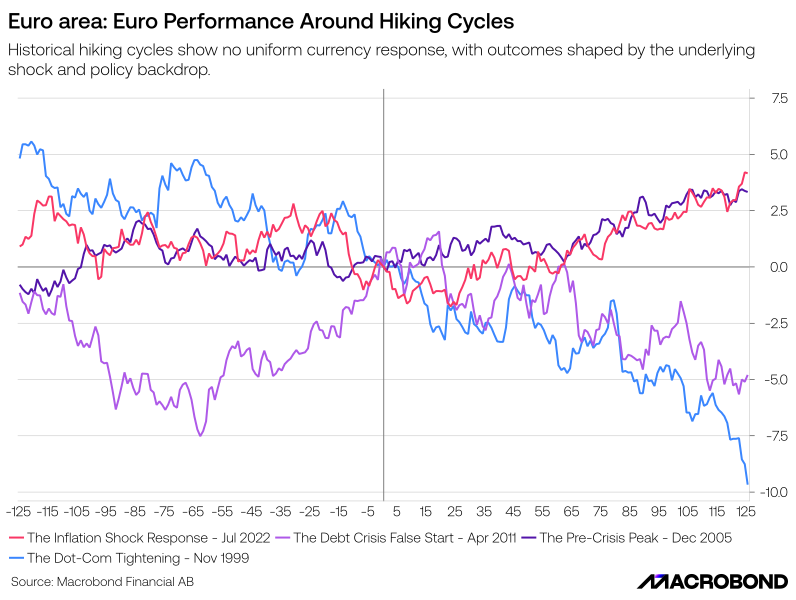
Euro performance around hiking cycles remains highly non-linear, driven less by rates and more by the nature of the underlying shock. The current backdrop most closely resembles 2022, where tightening coincided with currency weakness as an energy-driven terms-of-trade shock eroded real incomes and external balances. Earlier cycles differed: 2005 reflected global expansion, while 2011 reversed on sovereign stress. With energy again central, the euro’s path is more likelytied to external balances than policy differentials.