

A bi-weekly look at the trends driving economies and investments worldwide.



The Signal Is Real But Inconsistent: ENSO cycles correlate with specific commodity price moves across decades of data. El Niño has broadly coincided with higher prices in tropical agricultural commodities, but the magnitude swings wildly cycle to cycle and other factors frequently drive more of the move than the weather does.
It Hits Some Countries Much Harder Than Others: Where agriculture is a large share of GDP and food is a large share of CPI, an ENSO-driven harvest shock hits growth, fiscal balances, and inflation at the same time. That divergence across emerging markets shows up in the data before it shows up in asset prices.
A New Cycle Is Now Building: NOAA puts El Niño probability at 80%+ for June-August 2026, with a 6-12 month lag before production impacts typically materialize. Whether this becomes a moderate or strong event remains to be seen. The historical record across multiple cycles is the reference point for what to monitor.
Insights
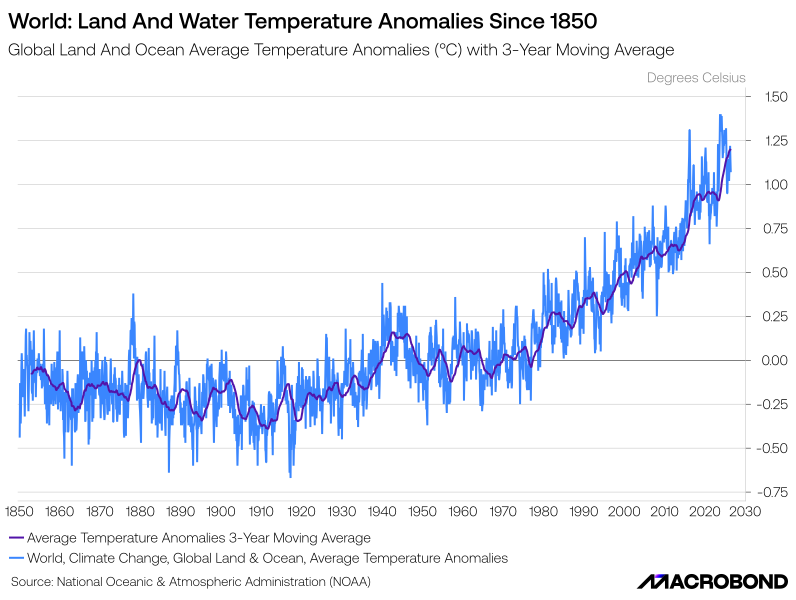
Global land and ocean temperatures have risen ~1.5°C since 1850, with the most pronounced acceleration occurring post-1980. The 3-year moving average has never been higher in the recorded dataset, and year-to-year variance is widening, the swing between annual highs and lows is larger now than at any prior point in the 175-year record. Warmer baseline ocean temperatures directly fuel El Niño intensity and the Pacific warming that drives ENSO is occurring on top of an ocean already at record heat levels.
Insights
The Oceanic Niño Index measures the three-month running average of sea surface temperature anomalies in the Niño 3.4 region, with readings at or above +0.5°C defining El Niño conditions and readings at or below -0.5°C defining La Niña. The 2015/16 episode stands out as the most intense of recent decades, with the index approaching +3°C at its peak. After the extended La Niña conditions that persisted through much of 2022–2023, the index has turned positive again and is trending back toward El Niño territory. Whether this develops into a moderate or strong event will become clearer over coming months, but the directional signal points to a warming cycle in progress.
.svg)
Insights
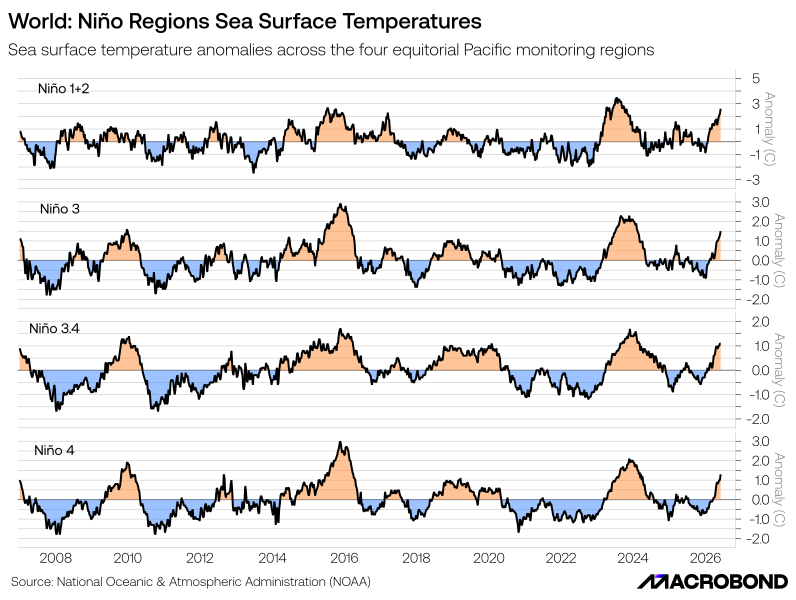
NOAA monitors sea surface temperature anomalies across four regions of the equatorial Pacific — Niño 1+2, 3, 3.4 and 4 — each responding at different speeds and intensities during an ENSO event. Across all four panels, anomalies have recently turned positive after a prolonged cool phase, with orange shading re-emerging in the most recent observations. The warming is broadening from the eastern Pacific inward, consistent with the early development of a canonical El Niño. The Niño 1+2 region, covering the South American coastal zone, is showing some of the sharper recent anomalies — a signal closely associated with rainfall disruption across Peru, Ecuador and northern Brazil.
Insights
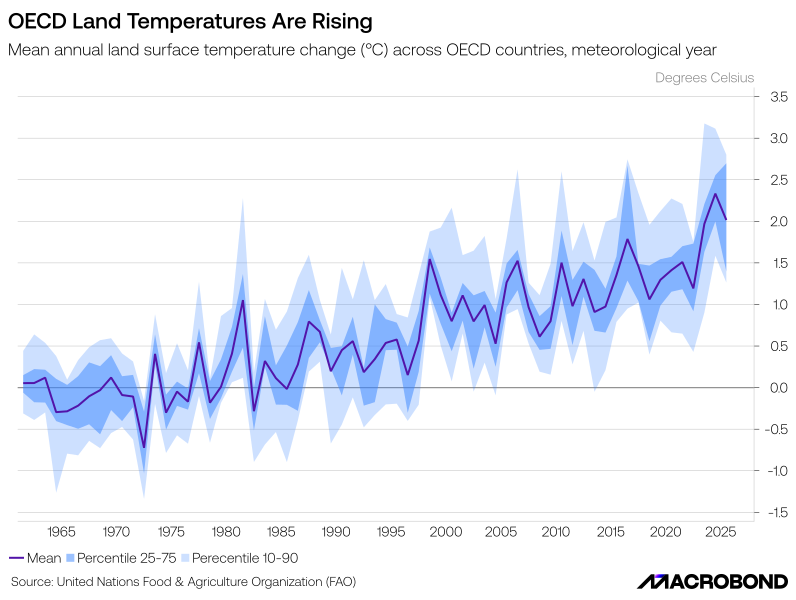
Mean land surface temperatures across OECD countries have risen roughly 2°C since the 1960s. This is relevant context for agricultural production in developed economies. Heat stress and irrigation demand are already elevated before ENSO adds additional pressure. It also matters for disaster costs: the same flood or drought event causes more damage at higher ambient temperatures.
Insights
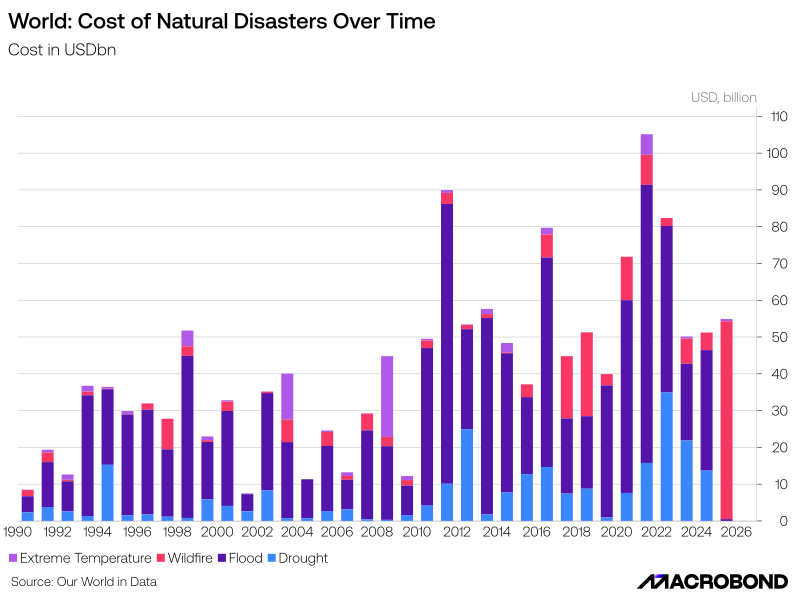
The global cost of natural disasters has risen from under $20bn annually in the early 1990s to repeated spikes above $80–100bn since 2010. Floods dominate the total in most years. The standout is 2022 at over $100bn, the single most expensive year in the dataset. Two structural shifts are visible. First, the floor is higher, even the quiet years post-2010 exceed the peak years of the 1990s. Second, extreme temperature events are a growing share of the total, nearly absent before 2000 and now a consistent contributor every year.
Insights
Agricultural value added as a share of GDP is substantially larger in developing economies, and it is this structural dependence that makes El Niño a material macroeconomic risk rather than a contained sectoral event. Ethiopia leads the sample at over 30% of GDP, with Nigeria, Pakistan and Tanzania all above 20%. For these economies, a sustained weather shock feeds directly into output, rural employment, trade balances and government revenue. The contrast with lower-dependency markets like Russia, Poland and South Africa — where agriculture is a low single-digit share of GDP — illustrates how unevenly El Niño risk is distributed across the emerging market universe.

Insights
Sugar, fishmeal, cocoa, and palm oil show consistent positive price moves across El Niño cycles, with the standout being cocoa's roughly 250% move in 2023-2024.
These commodities have multiple independent price drivers. Palm oil moves on Indonesian and Malaysian policy, biofuel mandates, and Southeast Asian weather broadly. Fishmeal is driven by Peru's anchovy quota management and fishing regulations independent of ENSO. Sugar is influenced by Brazilian ethanol policy, Indian export restrictions, and currency moves in the Real.
The 2023-2024 cocoa move cannot be read as a clean El Niño story. The 2015-2016 El Niño was rated "very strong" and produced only minor cocoa price movement. What made 2023-2024 different was extreme rainfall in December 2023 causing black pod disease, immediately followed by El Niño-driven drought in February 2024, hitting crops that were already weakened. Aging tree stock, Cocoa Swollen Shoot Virus, and two consecutive below-average harvests meant there was no buffer when the weather shock arrived.

Insights
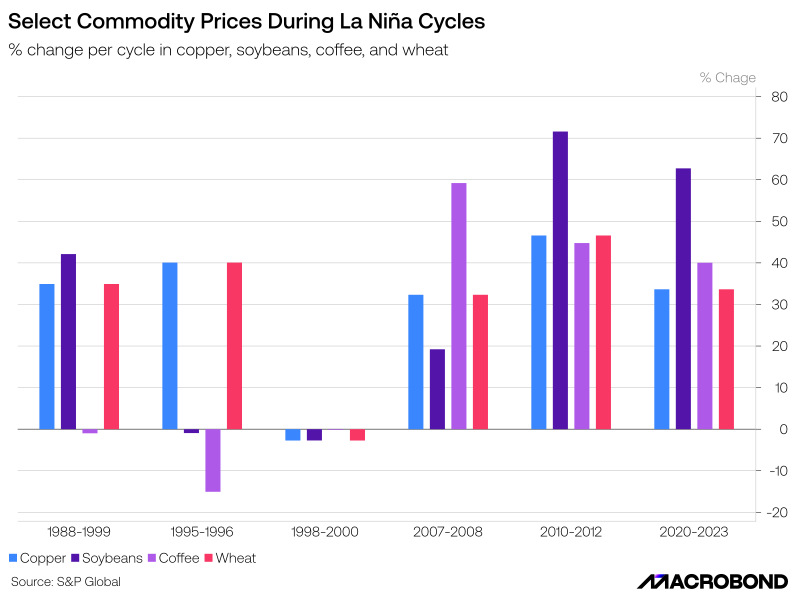
Copper, soybeans, coffee, and wheat all show consistent positive price moves across La Niña cycles, with the largest moves in 2010-2012 and 2020-2023.
These commodities have multiple independent price drivers. Copper moves on Chinese industrial demand and the energy transition. Soybeans on US-China trade flows and Brazilian harvest cycles. Wheat on geopolitical disruption, Russia's 2022 invasion of Ukraine, which supplies 30% of global wheat exports, was a primary driver of the 2020-2023 price move shown here. Coffee on Brazilian production cycles and currency moves.
Insights
Indonesia and Malaysia together supply the large majority of global palm oil, making their export volumes a key indicator of El Niño's impact on tropical agricultural production. El Niño typically brings prolonged dry conditions to Southeast Asia, suppressing yields across the oil palm regions of Sumatra, Kalimantan and Peninsular Malaysia. The shaded bands marking the 1997/98, 2015/16 and 2023/24 episodes each coincide with periods of export disruption or deceleration in one or both series. With a new El Niño signal now building, any meaningful yield reduction would tighten global vegetable oil markets and put upward pressure on food prices across import-dependent economies.

Insights
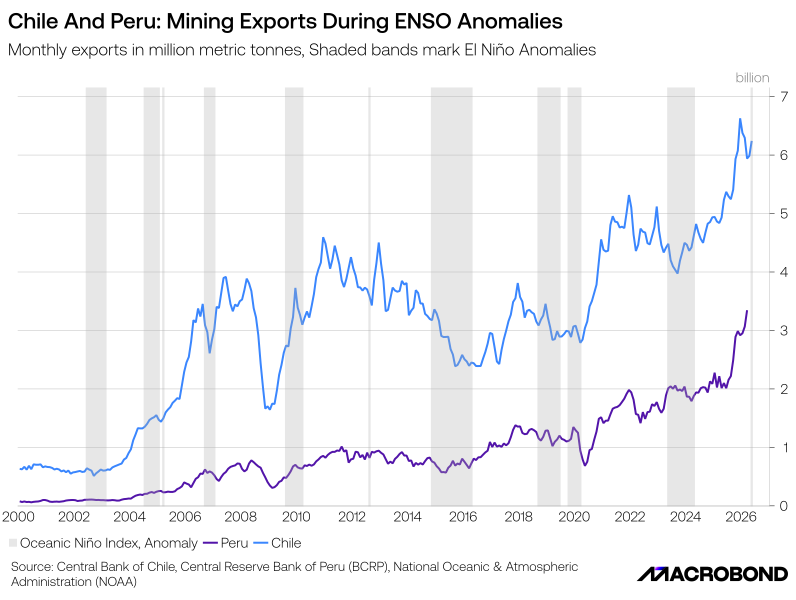
Chile and Peru mining exports have grown substantially since 2000, driven primarily by Chinese demand and new capacity additions. The long-run trend runs through every ENSO episode on the chart.
The disruptions are episodic. El Niño brings heavy rainfall to Chile, reducing access to mountainous mining regions where large copper deposits sit. Drier El Niño conditions also restrict maritime traffic reduced water levels during the previous El Niño resulted in weight limits and surcharges on Panama Canal shipments. Chile's export line shows more pronounced dips around the shaded El Niño bands than Peru, whose growth has been comparatively steadier. Both countries are now at record export volumes.
Insights
This chart combines three dimensions of El Niño vulnerability: fiscal position, agricultural dependence and food's weight in the CPI basket. The most exposed cluster sits toward the upper right, where high agricultural GDP shares coincide with significant fiscal deficits — Pakistan and Nigeria stand out, with large bubbles confirming that food also carries heavy CPI weight. An El Niño-driven production shock in these economies would simultaneously pressure growth, strain public finances and transmit rapidly into consumer prices. At the other end, lower agricultural GDP shares and smaller food CPI weights in markets like Russia, Poland and the Latin American economies mean the macro transmission is more attenuated. The chart illustrates that El Niño's macro significance is not uniform — it is most acute where production, inflation and fiscal vulnerabilities align.


