

Stagnation, Inflation & Oil Shocks - Everything That Moves the Global Economy and Your Portfolio

In March, the global economy was reminded of how quickly the past can resurface. The closure of the Strait of Hormuz sent fuel prices soaring and revived familiar worries - echoes of the energy shocks of the 1970s.
With geopolitical risks rising and energy markets tightening again, parallels to that era are easy to draw. But they’re better viewed as perspective, not prediction: today’s economy, energy mix, and policy tools differ dramatically from those of fifty years ago.
Still, with inflation concerns returning and supply routes under pressure, the 1970s offer a useful benchmark. This edition of Macro Moves explores how today’s disruptions might ripple through inflation and markets -and what history can teach us about the path ahead.

The recent shutdown of the Strait of Hormuz has pulled a significant share of global oil supply off the market, prompting immediate comparisons to the 1973 oil embargo. Back then, just a few months of disrupted supply not only sent prices soaring but also pushed much of the world into years of slow growth and stubborn inflation.
Today, with geopolitical risks rising and energy markets tightening once again, analysts are increasingly drawing parallels to that earlier crisis. When oil prices rise that sharply, the effects spread quickly across households, businesses, and supply chains. Whether through higher transportation costs, increased input prices, or a general rise in the cost of goods and services, the consequences are felt widely and rapidly.
While today’s economy is very different, the scale of the current shock is difficult to ignore. Oil prices have been pushed far outside their typical historical range, underscoring why the echoes of that earlier era feel particularly relevant once again.
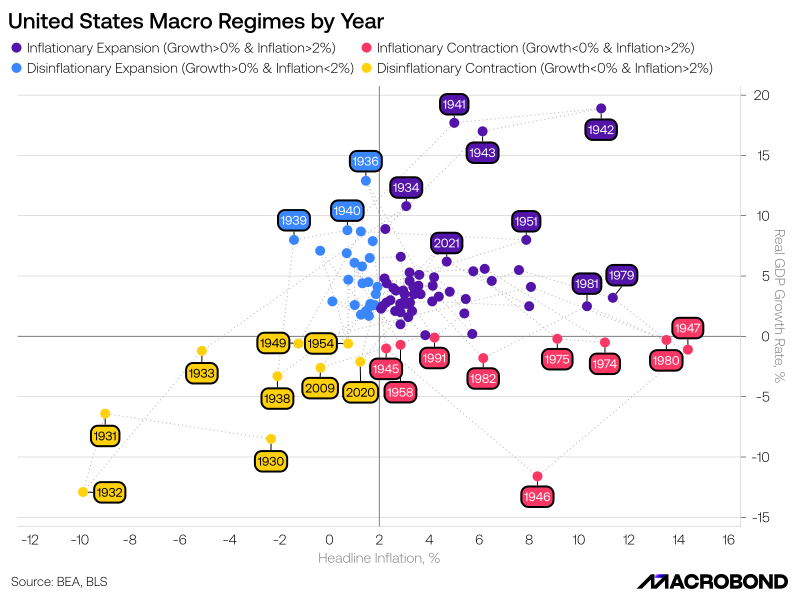
Whenever the 1970s come up in an economic conversation, the first word that tends to show up is stagflation. The term has become a kind of shorthand for the mood of that decade - an era of long lines at petrol stations, sudden energy shocks, and policymakers struggling against forces that pulled the economy in opposite directions. It’s one of those concepts that sits somewhere between economics and cultural memory: everyone speaks (or remembers) of “how bad the 70s felt”, even if the underlying economic conditions were far more complex.
This emotional weight is why stagflation remains such a powerful reference point today, despite the world having changed dramatically since then. But behind the nostalgia, fear, or overuse of the term, there’s still a specific economic pattern worth looking at.
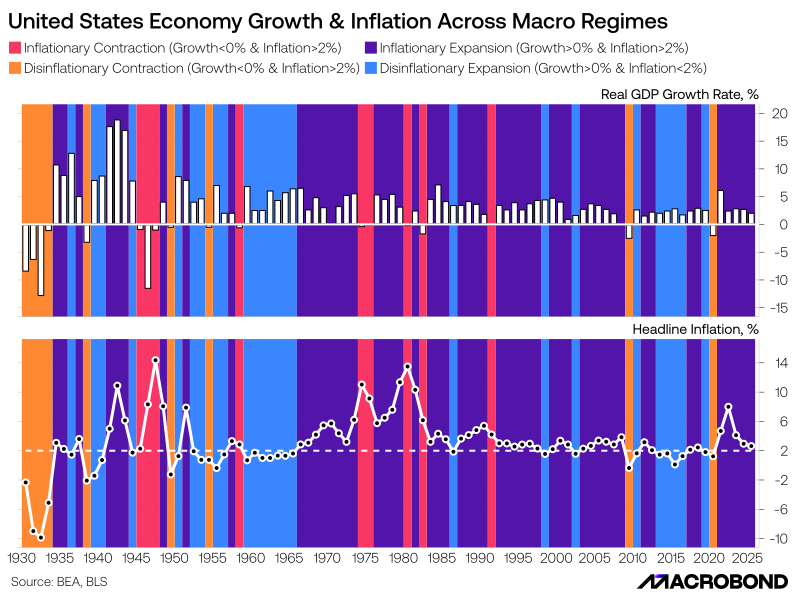
It’s not the easiest concept to pindown. In the simplest terms, stagflation describes an economy stuck in an unusual combination: weak or negative growth paired with high inflation. Economists often treat inflation above roughly 2% alongside falling output as the basic threshold.
Historically, this has been a rare economic regime. Since the 1930s, only a few periods clearly fit the definition:
In most cases, stagflation emerged after major supply disruptions, especially in energy markets. That’s what makes the 1970s such a dominant reference point - and why economists pay especially close attention whenever global energy flows look vulnerable. The term “stagflation” carries heavy historical baggage, but at its core, it simply describes a moment when the economy feels pulled in two opposite and equally uncomfortable directions.

With inflation back at the center of public debate, it’s natural to wonder whether today’s economy is in any way retracing the path of the 1970s. But drawing clean historical parallels is rarely straightforward. When you stitch together data across multiple decades, it becomes surprisingly easy to spot patterns that look more convincing than they actually are. Different time horizons, policy frameworks, and economic cycles introduce a long list of caveats - and plenty of opportunities to misread the noise.
Still, it’s hard to deny that charts like the one below can be visually persuasive. They make you pause and think, “Maybe there’s something to this”, before you remember that the resemblance often says more about the chart design than about the underlying economics.
In other words: interesting to look at, useful for sparking discussion - but not a roadmap for where inflation goes from here.

It’s a difficult question to answer definitively, but one of our infographics offers a useful perspective. It illustrates the average contribution of energy and food to headline inflation over the past ten years across 30 countries. Crucially, this is not the inflation rate itself. Instead, it should be read as: “In country X, energy accounted for 33% of the increase in headline inflation over the past five years”. Think of it as an alternative lens for understanding how the structure of everyday spending differs across economies.
The takeaway is fairly intuitive. Countries where energy has historically contributed the most to inflation tend to feel an oil‑price shock first and most directly. Then, with some delay, elevated energy costs begin to feed into food production and transportation. That second wave typically hits economies where food has been the dominant driver of inflation in recent years - the ones captured in the second column ofthe chart.
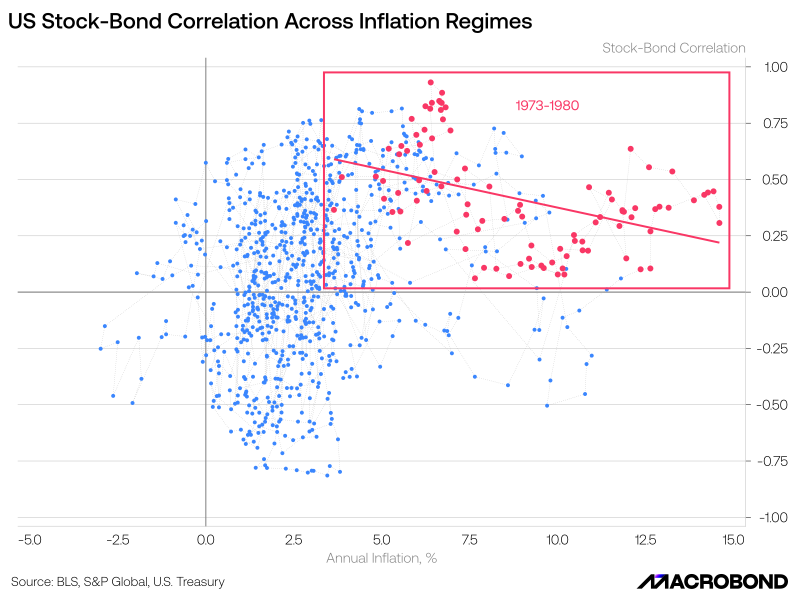
The usual logic goes like this: high inflation tends to erode the value of most financial assets. So instead of asking whether markets will “suffer”, a more useful question is how diversification behaves when inflation rises. In other words: do stocks and bonds continue to move together, or do they regain their role as natural diversifiers?
History gives mixed signals. During the mid‑1970s, when inflation surged dramatically, the correlation between stocks and bonds remained broadly positive - meaning both struggled at the same time. But that’s only one chapter. The challenge is that historical inflation shocks don’t produce a single, predictable market pattern. The outcome depends on what’s driving the inflation, how central banks respond, and whether the shock hits growth or only prices.

More than a 74% increase in jet fuel, nearly a 60% surge in gasoline, and a 57% jump in diesel - March was an exceptionally difficult month for transportation costs. The recent closure of the Strait of Hormuz, one of the world’s most critical energy corridors, added extreme pressure to already‑tight global fuel markets.
Energy now dominates virtually every price ranking - monthly, year‑to‑date, and across broader measures. And the impact goes far beyond what consumers all around the world see at the pump.
Oil is embedded throughout the economy: in natural gas for cooking, heating oil for homes, plastics, pharmaceuticals, fertilizers, industrial chemicals, and the logistics networks that move goods around the world. In many respects, oil is not merely a part of the global economy - it is the economy itself.
When oil prices rise sharply, the effects spread quickly across households, businesses, and supply chains. Whether through higher transportation costs, increased input prices, or a general rise in the cost of goods and services, the consequences are felt widely and rapidly.
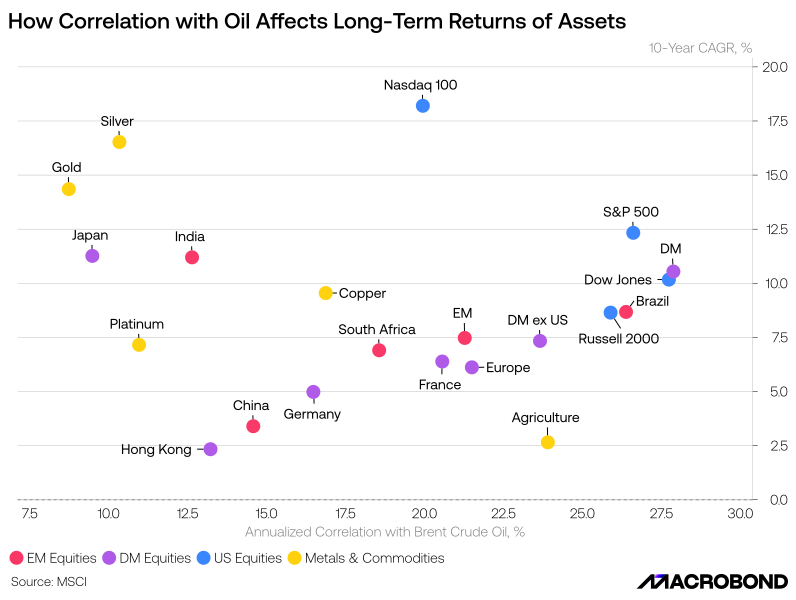
Oil price swings rarely stay limited to the energy sector. They tend to ripple across a wide range of assets - but not in a straightforward or predictable way. Oil is only one piece of a much larger market landscape, and its link with asset returns is far from linear.
Across major asset classes, the picture is mixed. The Nasdaq‑100, a tech‑heavy index with strong long‑term returns, shows only moderate correlation with oil. Gold and silver deliver slightly lower returns but display even weaker connections to crude prices. Meanwhile, the S&P 500, despite its higher historical correlation with oil, has posted more modest performance.
In short, oil doesn’t provide a simple signal for broader market returns. Markets react not just to the level of prices, but to the underlying drivers - whether the shift is rooted in demand, supply disruptions, geopolitics, or policy. Each episode leaves a different imprint on equities, commodities, and bonds.

In March, oil jumped more than 40% - an unusually sharp move for a single month. A shock of that size rarely stays isolated, and history offers at least some guidance on how markets tend to react.
Looking at past episodes of similar oil spikes, the pattern is surprisingly consistent. In the year that follows, the S&P 500 typically becomes the strongest performer, followed by emerging‑market equities and then European stocks. Japan tends to sit somewhere in the middle of the pack.
Gold is usually the laggard. That may sound counterintuitive, because gold is traditionally seen as a safe‑haven asset - something that should benefit during geopolitical disruptions, when oil often rises as well. And historically, that link did exist.
But in recent years, gold has become more speculative and more sensitive to interest rates, slowly losing some of its classic safe‑haven behavior. As a result, its performance after large oil shocks has been far less reliable.

Let’s end on a brighter note - because the 1970s weren’t only about oil shocks and geopolitical tension. They were also the era of disco, denim, and humanity’s first giant leap into space. After Neil Armstrong’s landing in 1969, the early 1970s saw several more lunar missions. But then the Moon went quiet. Since the last Apollo mission in 1972, the share of U.S. federal spending devoted to space exploration has steadily fallen, from a peak of about 2.15% in 1965 to roughly 0.3% in recent years.
Now, more than half a century later, that trajectory is shifting. In April 2026, NASA’s Artemis II mission carries humans around the Moon for the first time since the early 1970s. No astronaut will step onto the surface just yet - that milestone is planned for 2027-28 - but the mission still marks a major moment for global space exploration. After half a century, humanity is once again preparing to look back at Earth from lunar distance.
A reminder that even in periods of uncertainty, progress continues - and some ambitions remain firmly aimed upward.


