

Clear insights on the market moves defining the close of 2025.

As 2025 approaches its finish line, investors, economists and policymakers are left with a complicated mix of emotions. This was a year that refused to sit still – a year of economic surprises, market whiplash, shifting narratives and sudden changes in sentiment. And its final month, December, is proving just as important as everything that came before it.
In this edition of Macro Moves, we bring together the key developments from the past month to help you enter the holidays with a clear, data-driven view of the world.
New York’s housing market is facing growing pressures as high prices and limited supply continue to shape local conditions. While overall price growth has been modest compared with neighboring states, significant differences between home types reveal deeper structural pressures.
What do these developments signal for New York’s housing market - and what risks and opportunities do they create?
Over the past four years, the median home price across New York State has risen by just 14%, making it one of the slowest-growing housing markets in the United States. The stagnation stands in stark contrast to neighboring states: both New Jersey and Connecticut saw prices surge nearly 40%, while Pennsylvania recorded a 22% increase.

But New York’s issue is not in sluggish growth - it is, above all, a worsening problem of affordability.
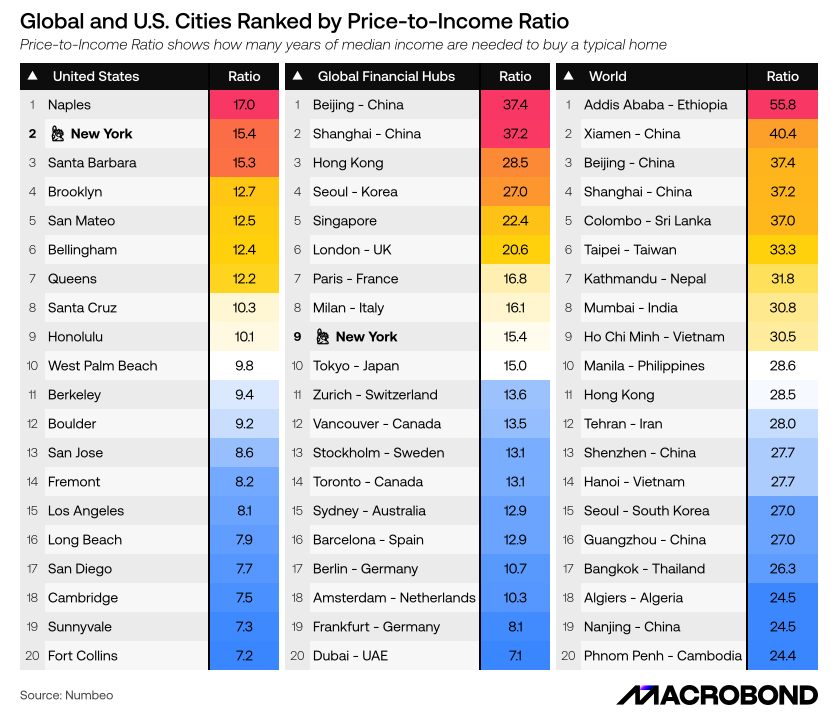
The median home price now stands above half a million dollars, placing the state among the least affordable in the US. For the average New Yorker, buying a home requires the equivalent of roughly 15 years of income, the second-worst affordability ratio in the entire country, surpassed only by Naples, Florida – the so-called “World Capital of Golf”.
Globally, New York is far from topping the list of the world’s least affordable cities. Yet when compared with peer financial hubs –Tokyo, Zurich, Toronto – it stands out: New Yorkers must commit more years of earnings to purchase a home than residents in many of the world’s other major economic centers.
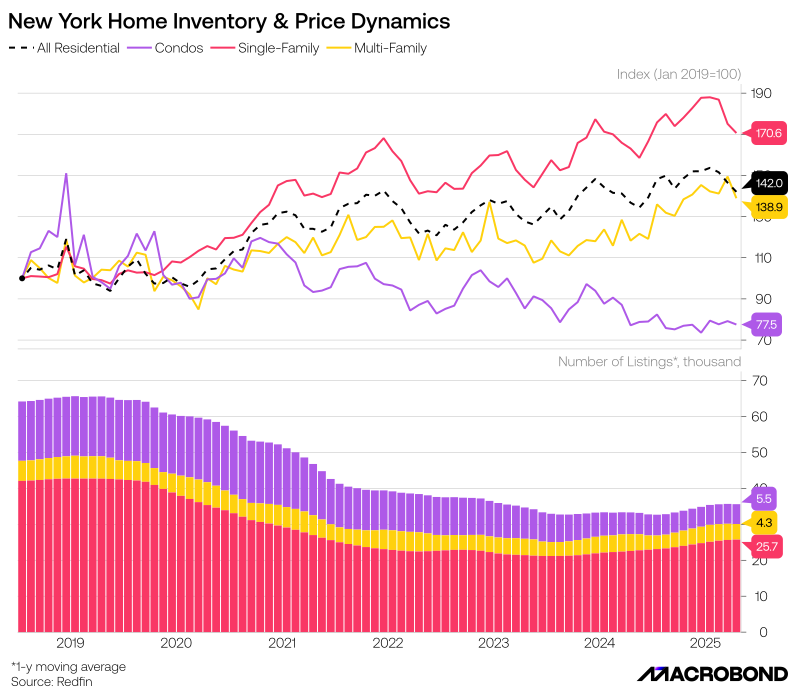
At the same time, to say that New York’s housing market has no structural issues would be inaccurate. The supply of single-family homes – the most common type of housing in the state – has halved since 2019, leaving only about 25,000 active listings on the market.
The pressure on prices has also been highly uneven. Since the pre-Covid period, overall residential prices have climbed roughly 40%, a figure that masks deep divergence within the market. Single-family homes surged by nearly 70%, while condominium prices fell by more than 20%, offsetting part of the statewide increase.
The State of New York Housing:
Affordability remains the central challenge in New York’s housing market, as high prices and limited supply continue to strain residents.
In a city that often influences broader economic trends and market expectations, housing market carries both potential risks and opportunities - and it will be important to monitor in the months ahead.
“I’m going quiet…” – with those few, almost whispered words, Warren Buffett closed the book on one of the most remarkable careers in financial history. As readers reached the final lines of his farewell letter, many felt an unexpected heaviness – that quiet pause before emotions settle in.
This month, Buffett steps down as CEO of Berkshire Hathaway, in the same way he built his legacy: quietly and humbly. For more than six decades, he has been a steady hand and rational voice, building one of the world’s most successful companies and changing how generations think about investing.
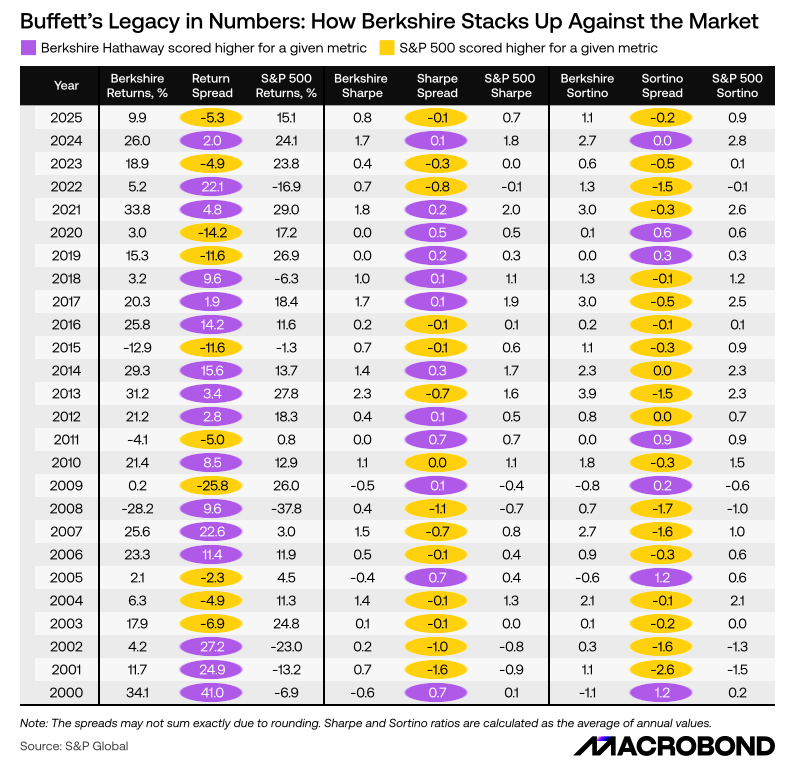
His strategy was never complicated. It was simple, consistent and almost stubbornly reasonable. And it worked. Over the past 25 years, Berkshire Hathaway outperformed the S&P 500 in 16 of them, often delivering its strongest results when markets were in turmoil: Dot-Com Crash, Global Financial Crisis and Covid-19.
No one can say with certainty what lies ahead for Berkshire Hathaway. In May, Buffett announced that Greg Abel would succeed him as CEO, and many believe he is well equipped to preserve the company’s culture. Abel is known for his strong work ethic, steady strategic judgment and firm commitment to the value-investing principles that shaped Berkshire for decades. Time will tell whether he manages to carry forward Buffett’s legacy – or perhaps build one of his own.
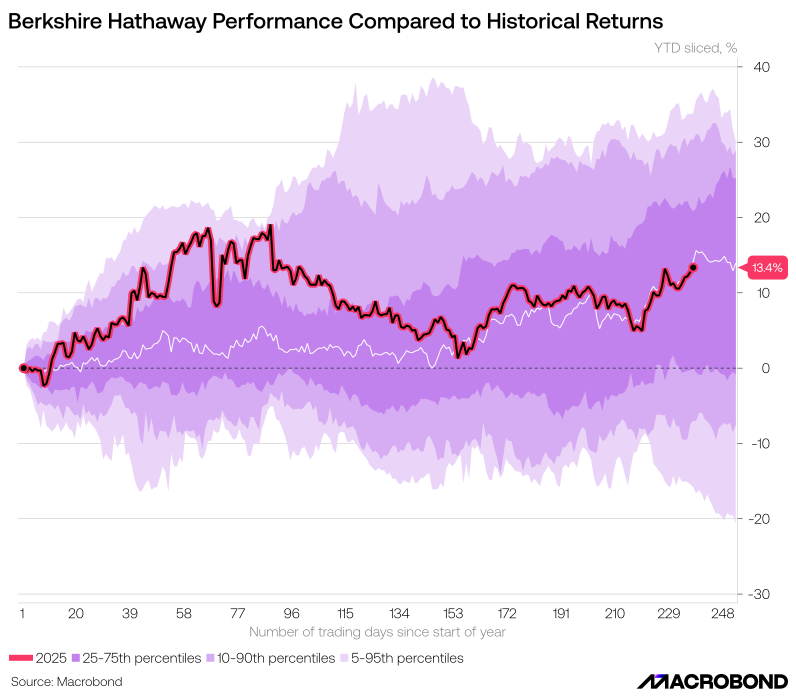
What is clear is that 2025 has already emerged as one of the more anxious years in recent memory. Yet even in this uneasy environment, Berkshire delivered solid returns of around 12%. The company is slightly trailing the S&P 500 at the time of writing, but still posting a respectable, almost “average” performance – a reminder that resilience, not spectacle, has always been its defining trait.
Now, as the Oracle of Omaha finally steps back, the financial world feels the shift. Buffett’s presence meant stability. It meant clarity in uncertain times. It meant a reminder that investing, at its core, isa discipline shaped by humility, logic and integrity.
“Choose your heroes very carefully…” Buffett said in his final letter. And for millions, he became exactly that – a hero, a mentor and a compass in the noisy world of financial markets.
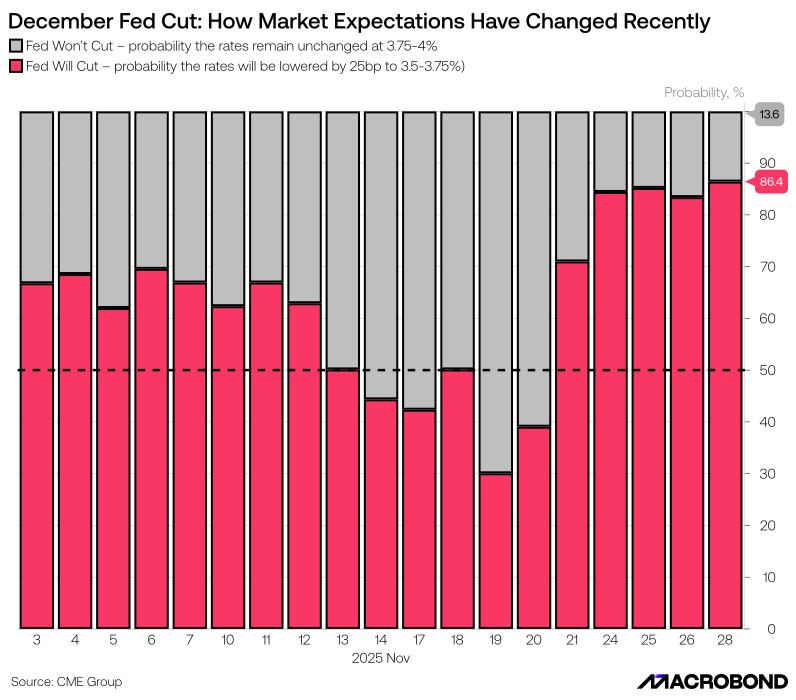
As the last FOMC meeting of this year approaches, uncertainty grips markets. Many investors are asking themselves the same question: what to expect on December 10? Will the Fed deliver another rate cut this year, or keep rates steady? How should one prepare for what comes next? The truth is, no one can say for sure – and that uncertainty makes this one of the most unpredictable FOMC meetings in recent memory.
Since the Fed delivered its long-awaited – and, as some say, overdue – cut in October, markets have not merely adjusted expectations. They have swung wildly, from euphoria to extreme anxiety, with every new signal triggering fresh waves of speculation.
November, in particular, has been a whirlwind. Immediately following the October meeting, optimism ran high: investors priced in at least one more cut by year-end. By mid-month, however, the Fed adopted a surprisingly hawkish tone. The probability that rates would remain unchanged shot up to 70%, sending markets into a brief panic. And then, almost overnight, the narrative flipped once more: the likelihood of another cut now exceeds 80%.
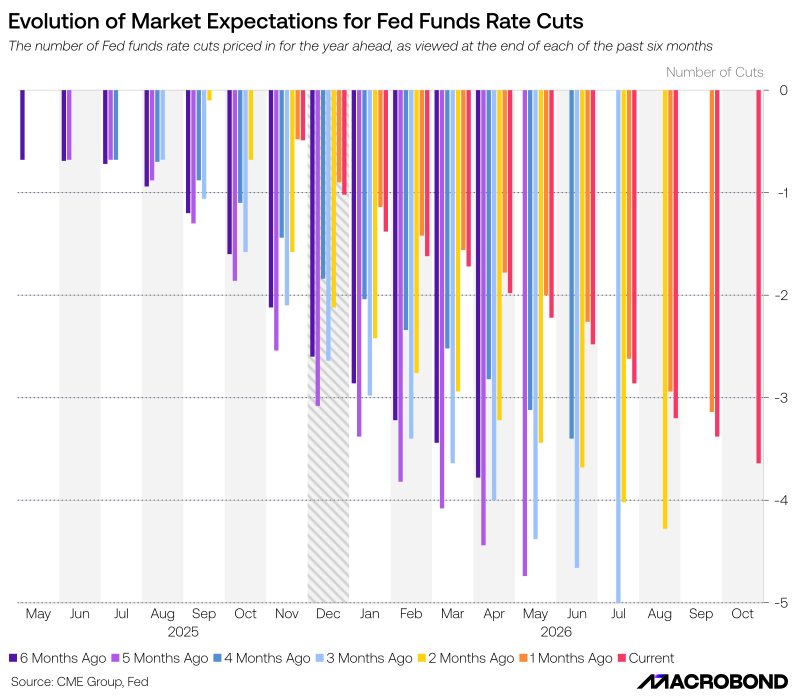
Half a year ago, markets were expecting two – possibly even three – cuts by the end of 2025. So far, only one has been delivered and hopes for more have clearly faded. Looking further ahead, investors remain cautiously dovish, anticipating roughly four cuts by the fall of 2026. Yet history suggests that the appetite for rate reductions often diminishes when reality proves less accommodating than expectations. The months ahead could once again test that patience and market swings may remain sharp as investors react to every signal from the Fed.
Expect the Unexpected?
For anyone watching the markets right now, one thing is clear: stay flexible and alert. Probabilities can swing wildly in just a few weeks, so it pays to be ready for more than one scenario.
“One of the Worst Months Since the Covid Crash” – that was the headline dominated across crypto media in November, as Bitcoin dipped below the $90,000 mark – a level many saw as psychological threshold. And there action wasn’t exaggerated: monthly performance indeed fell more than 20%, marking one of Bitcoin’s weakest stretches since the Covid-era crash.
Yet the drop came without any single “big” event to blame. Instead, a handful of quieter factors pulled the market downward.
Three Reasons for November’s Crypto Pullback
The first was the general nervousness surrounding global markets. Anxiety over a potential AI bubble has been building for months, and Nvidia has become the unofficial mood indicator. Its latest earnings were solid, but the stock still fell the following day – not because of numbers, but because the market is increasingly afraid that the AI story may soon lose its spark.
Then there was the Fed – switching from hawkish to dovish and back again in a matter of days. As we wrote earlier, the November expectations cycle was chaotic, and crypto felt the impact. Despite constant pledges from crypto enthusiasts about “independence” from traditional finance, the truth is simple: the more institutional money flows into crypto, the more the Fed matters. Bitcoin can’t fully detach from the macro world that now hold sit.
A third blow came from the departure of institutional investors and long-term holders. Several banks reportedly reduced their BTC exposure and some of crypto’s larger “whales” began selling as well. The world even gained a new billionaire – Owen Ganden – a long-time holder of more than 11,000 Bitcoins, who sold his position on 22 November, cashing out roughly $1.3 billion.

So… What’s Next for Bitcoin?
It’s impossible to say with certainty. Many point out that Bitcoin has survived deeper crashes before. Yet for traditional skeptics –those who never accepted the idea that Bitcoin could resemble a “real” asset –the latest drop served as fresh confirmation that “Bitcoin is just another bubble”.

But there’s another side to this story. Bitcoin is now heavily interconnected with traditional markets. Current data shows its annualized correlation with the S&P 500 has reached nearly40% – levels last seen during the Covid period. What’s more surprising, at this moment there isn’t a single S&P 500 sector showing negative correlation with Bitcoin. For some, that’s a warning sign. For others, it’s a signal that Bitcoin has finally become an integral part of the broader financial landscape.
As we slowly approach the holiday season – with many of us putting up Christmas trees and buying presents for our loved ones – seasoned investors remember that this time of year isn’t only about celebration. It also brings a curious market pattern: the Santa Claus rally.
But what exactly is it, and how can one benefit from it?
The Santa Claus rally refers to a seven-day period that covers the last 5 trading days of the year plus the first 2 of the next one. And, historically, this short window has offered surprisingly strong returns.
Even though the rally is well known today, there’s still no clear explanation for why it happens. Some say it’s simply the holiday mood spilling into the markets and investors feeling optimistic. Others believe it’s because many institutional investors take time off, leaving the market more influenced by retail traders, who tend to be more bullish.
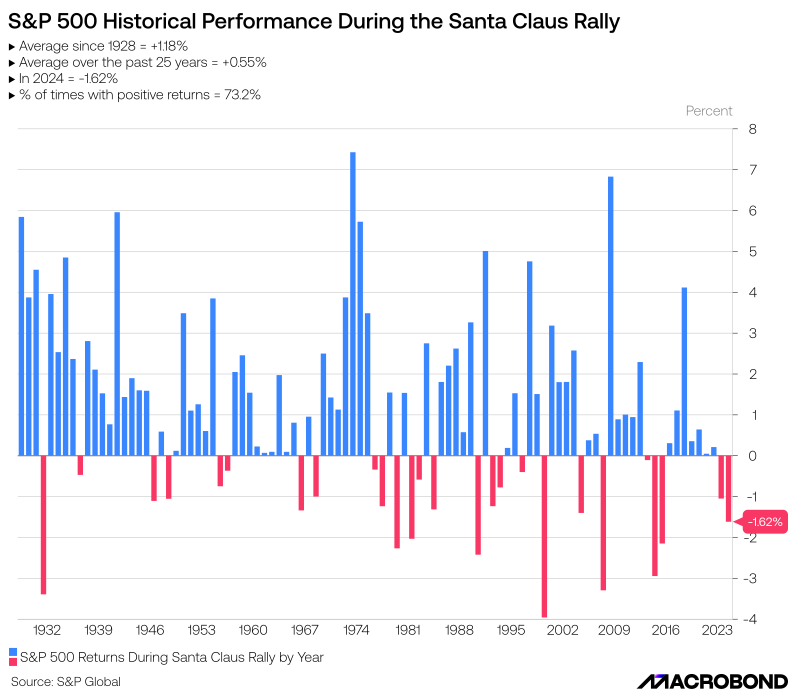
Whatever the cause, the numbers are striking. Over the past century, the S&P 500 has gained an average of 1.18% during the Santa Claus rally. Yet there is a huge “BUT”. Over the past 25 years, the average return has slipped to just 0.55%, and the last two Santa Claus rallies actually ended in negative territory.
So… has America lost its holiday spirit? Perhaps. Or perhaps today’s markets simply aren’t as optimistic as history suggests. Either way, we wish our readers a calm, joyful and prosperous holiday season – whatever the market moves may bring.


