

Agriculture, Energy Prices & Food Inflation - Everything That Moves the Global Economy and Your Portfolio

In recent months, global markets have been reminded that not all strategic commodities come from oil wells or metal mines. Disruptions in the Middle East - from energy markets to shipping routes - have once again pushed fertilizers into the spotlight, revealing how closely food prices and energy are intertwined.
The closure of the Strait of Hormuz reignited concerns not only about oil supply, but also about fertilizer availability. Long treated as a technical agricultural input, fertilizers have re-emerged as a macroeconomic variable - one capable of transmitting energy shocks into food inflation.
This edition of Macro Moves explores how fertilizers have become a strategic crossroads of global markets - shaped by Middle Eastern energy dynamics, geopolitical risk and long standing agricultural cycles.
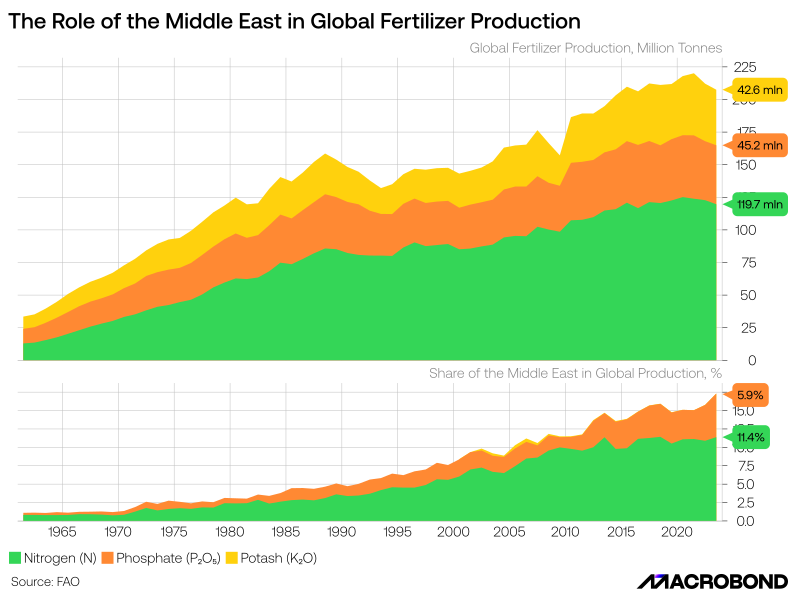
The recent closure in the Strait of Hormuz has done more than tightening global oil markets. It has also refocused international attention on another critical - yet often overlooked - pillar of global security: fertilizers.
The Middle East is widely known for its role in supplying energy to the world, but it is just as vital to global food production. Modern agriculture depends heavily on fertilizers to sustain crop yields, and without them, feeding today’s global population would be impossible. In this context, geopolitical tensions in the Middle East have implications that extend well beyond oil and gas - directly into the world’s food systems.
Fertilizers come in three main categories: nitrogen, phosphate and potash. Each plays a distinct role in plant growth, but nitrogen-based fertilizers are the backbone of modern agriculture, essential for boosting crop productivity across nearly all food systems. According to data from the Food and Agriculture Organization (FAO), countries in the Middle East account for roughly one-fifth of global fertilizer production, making the region particularly significant in the nitrogen market.
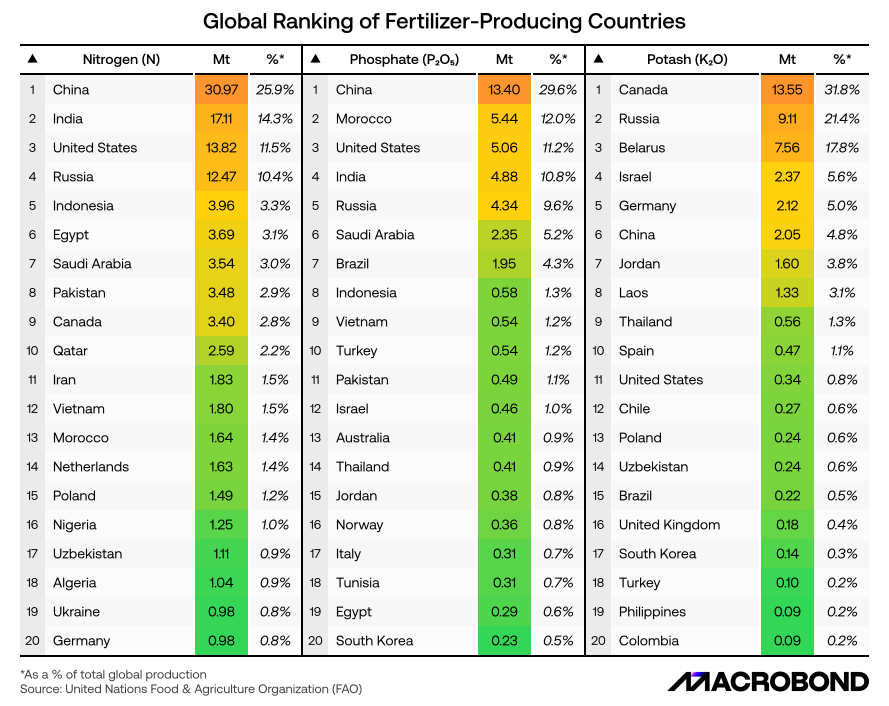
Even though individual Middle Eastern countries rarely appear at the very top of country-by-country fertilizer production rankings, the region as a whole occupies a remarkably strong position in the global industry.
Taken together, the Middle Eastern producers represent a dense and strategically located cluster of supply, particularly for nitrogen and phosphate fertilizers. Saudi Arabia alone accounts for roughly 3% of global nitrogen production and around 5% of phosphate output, according to industry estimates. Qatar and Egypt add further weight, jointly contributing another 5% of global nitrogen production, while also serving as key exporters to international markets.
What makes the Middle East even more important is not just production volumes, but export orientation. Much of the region’s fertilizer output is shipped abroad, making global markets directly dependent on the stability of Middle Eastern logistics, ports and shipping lanes. In this regard, the Strait of Hormuz plays a role comparable to that of an agricultural lifeline: any disruption can immediately affect fertilizer availability and prices worldwide.

The current geopolitical tensions in the Middle East highlight a broader reality: fertilizers - and agricultural commodities more generally - are highly sensitive to global political developments. Unlike many industrial goods, fertilizers sit at the intersection of energy markets, trade routes and food security, making them especially exposed to geopolitical shocks.
This sensitivity, however, has not been constant over time. During the 2008–2009 global financial crisis, it turned sharply negative, reflecting collapsing demand, falling energy prices, and weakened trade flows. Today, the trend is moving upward again. Renewed instability in the Middle East, tighter energy markets, and intensifying competition over food security are once more amplifying fertilizers’ exposure to geopolitical risk.
Agricultural commodities present as lightly different picture. Their sensitivity depends on how they are measured. Physical price indices - such as those compiled by the World Bank to capture macro supply-and-demand dynamics - tend to react directly to disruptions in production, logistics and trade. Futures-based benchmarks, like the S&P GSCI Agriculture Index, instead incorporate investor sentiment, hedging activity, and broader market cycles.

When discussing the Middle East, it is impossible to ignore oil shocks, which have repeatedly shaped global markets since the 1990s. From the Gulf War and the 2008 oil spike to the energy turmoil of the early 2020s, fluctuations in oil prices have consistently spilled over into fertilizer and agricultural commodity markets.
The key question is how closely fertilizers and agricultural commodities move with oil prices. Historically, the correlation has been strong. Fertilizers tend to mirror oil and gas price movements, reflecting their heavy reliance on energy as a production input. In one form or another, fertilizer prices have followed oil cycles, a pattern that remains visible again in 2026 amid renewed energy market volatility.
Agricultural commodities show a more uneven response. While futures-based markets often react quickly alongside energy prices, physical agricultural prices - measured at the macro level -tend to lag. This delay reflects the slower transmission of higher input costs into planting decisions, harvests, and global food supply.
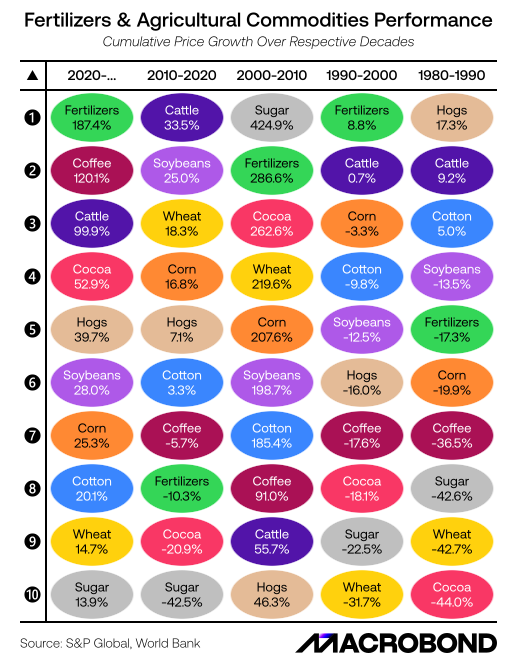
At first glance, fertilizers and agricultural commodities might be expected to move broadly in tandem over the long run. In practice, the relationship is more complex. Agriculture is not a single, uniform system, but a collection of diverse commodities, each shaped by different demand patterns, technologies, policies and climatic conditions. These differences become especially visible when viewed across decades.
The contrast is clearest in the 1980s and 1990s, a period marked by depressed prices across many major agricultural markets. Technological improvements, expanding arable land, weak demand growth, and low energy costs generated persistent oversupply, weighing on both crop and fertilizer prices.
The picture changed dramatically in the 2000s. During the first decade of the 21st century, fertilizer prices rose cumulatively by almost 300%, driven by higher energy costs, population growth, biofuel policies, and rising demand from emerging markets. Key crops - including wheat, corn, sugar, and cocoa - followed the same upward trajectory.
Momentum faded in the 2010s as productivity gains and relatively stable energy markets flattened prices. The 2020s, however, marked a renewed turning point, with supply-chain disruptions, energy shocks, and rising geopolitical risks pushing fertilizers back to the top of commodity performance rankings.

Moving from fertilizers to their end product - agricultural commodities - raises a natural question for investors: can agriculture be a profitable and sustainable investment? And how does it compare with benchmarks such as the S&P 500 or a classic 60-40 portfolio?
Based on headline numbers, the answer is mixed. Since 2000, agricultural commodities have delivered weak overall performance, with cumulative returns remaining close to or below zero. Early gains in the 2000s were largely erased in the post global financial crisis period, as excess supply, productivity improvements and subdued demand weighed on prices.
This pattern is also visible in long-term metrics. Ten year compound annual growth rates (CAGR) have been predominantly negative, briefly turning positive in the early 2010s and again more recently, but without establishing a durable upward trend. Compared with equities - and even balanced portfolios - agriculture has struggled to deliver consistent, long term returns, reinforcing its role more as a tactical or diversification asset than a standalone growth investment.

Nevertheless, a measured level of exposure to agricultural commodities may still be justified in a diversified portfolio. To explore this, we constructed an alternative version of the classic 60-40 portfolio by replacing 20% of the bond allocation with the S&P GSCI Agriculture Index. The resulting “AgriBalance” portfolio delivers mixed, but instructive results.
Overall, the strategy does not consistently outperform either its parent 60-40 portfolio or the S&P 500. Long-term returns remain inferior, underlining the challenge of using agriculture as a core growth asset. However, the AgriBalance portfolio does outperform during specific macroeconomic episodes, notably when inflation pressures rise or financial markets come under stress. In particular, stronger relative performance was observed in 2007, ahead of the global financial crisis, again in 2010 during the early post-crisis adjustment phase, and finally in 2022 when energy shocks and supply chain disruptions drove sharp increases in food and input prices.
The general takeaway is nuanced. Agricultural commodities may not enhance long term returns, but they can offer episodic diversification benefits - acting as a hedge during inflationary shocks or periods when equity-bond dynamics break down.
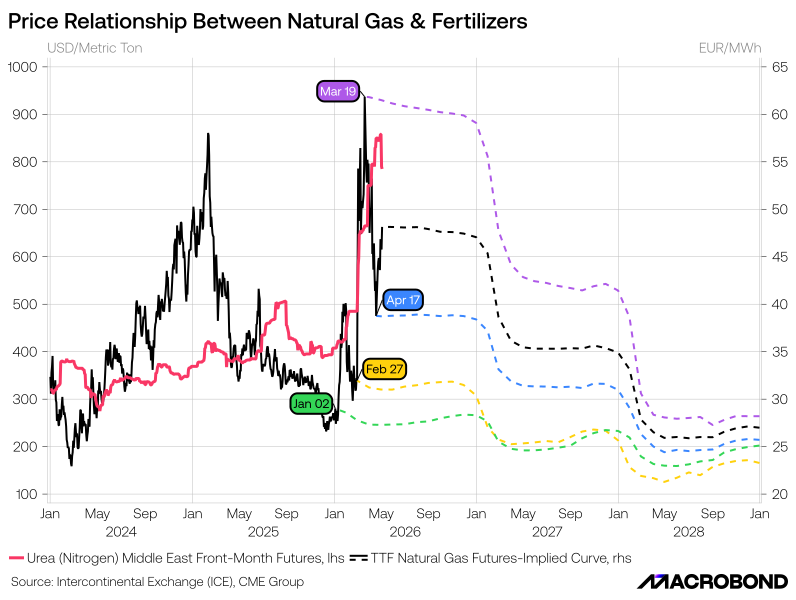
One critical link has so far remained in the background, yet it may prove decisive for what comes next: the tight connection between fertilizers - particularly nitrogen products such as urea - and natural gas, which serves as their primary production input. This relationship has long been structural, but recent market movements have brought it back into sharp focus.
Over the past months, prices of natural gas and nitrogen fertilizers have moved almost in lockstep. Rising energy costs quickly translated into higher fertilizer prices, reinforcing the role of energy markets as the main transmission channel for volatility. Now, however, gas markets appear to be shifting. Expectations of easing supply constraints and weaker demand have pushed natural gas prices lower, raising the possibility that fertilizer prices could follow with a lag.
Whether this decline materializes - and how far it goes - will depend on more than energy alone. Geopolitical risks remain elevated, particularly in the Middle East, where both energy and fertilizer supply chains converge. Any escalation could once again disrupt production, trade routes, or exports, limiting downward pressure on prices. At the same time, policy decisions related to food security, export controls and strategic stockpiling continue to play an outsized role.

Nevertheless, despite all the structural forces shaping fertilizer markets, one issue remains paramount for people around the world: food security - and fertilizers play a critical role in it.
The transmission chain is intuitive. When fertilizer prices rise - especially during the spring sowing season -production costs for farmers increase. Agricultural commodity prices typically follow with a lag of several months and food inflation eventually feeds through to consumers. This dynamic has been observed repeatedly.
We saw it during the global financial crisis and after 2022, when surging fertilizer and energy prices contributed to sharp increases in global food costs. Nearly every country felt the impact. Vegetables and fruits, meat and eggs, bread, sugar, coffee, and cocoa - almost all food categories depend, directly or indirectly, on fertilizers.
This is why fertilizer markets matter far beyond agriculture or commodities. They sit at the heart of the global food system. As prices stabilize, hopes rest on avoiding another spike in food inflation. But as past episodes have shown, fertilizers remain a powerful - and potentially volatile - link between geopolitics, energy markets and the price of food on household tables worldwide.


