

Technology, Labor & the Future - Everything That Moves the Global Economy and Your Portfolio

Artificial intelligence is no longer a distant or theoretical concept - it is increasingly changing how labor market functions. Yet despite the growing attention it receives, both the scale and the nature of this transformation are often misunderstood. AI is beginning to influence hiring practices, job design, and employer expectations, but its effects are uneven across sectors and frequently overstated in public debate.
This edition of Macro Moves examines how artificial intelligence is redefining work today - where its impact is already visible, where it remains limited and whatit means for the future of employment.
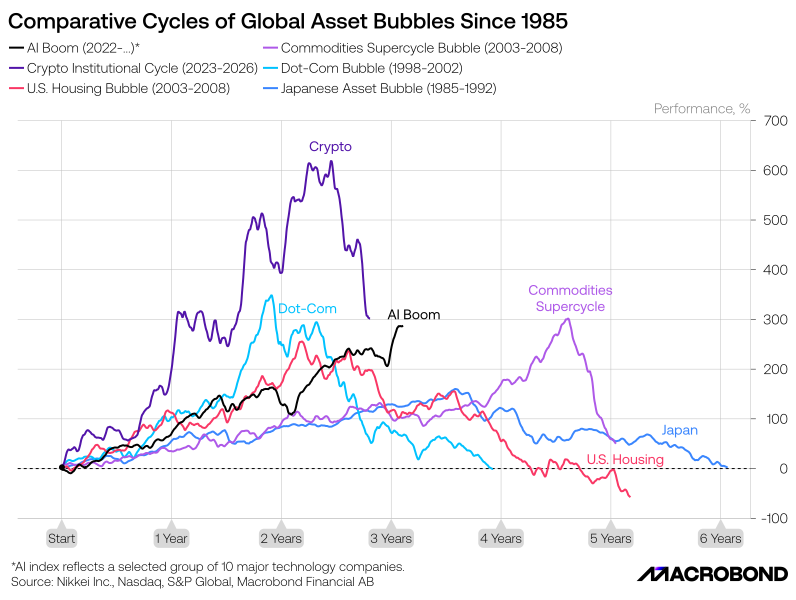
From the outset, artificial intelligence has sparked as much doubt as excitement. In many ways, that’s to be expected - each new wave of breakthroughs has been met with a familiar question: is this a real transformation, or just another cycle of overhyped expectations? That tension has become part of the AI story itself.
Looking back, this pattern feels familiar. Markets have gone through waves of rapid growth before - some later written off as fleeting excitement, others recognized as the start of lasting change. Where AI will ultimately land is still an open question. For now, though, there is little concrete evidence that would clearly place it in the “bubble” category.
Even so, the market response to AI has been hard to ignore. A custom index of ten large technology companies, including Nvidia, Microsoft and Amazon, has surged by nearly 300% since the launch of ChatGPT. That is a striking rise by any measure.
There are, of course, limitations to such comparisons. The story a chart tells often depends on where you choose to start and stop it - and those choices are rarely neutral. That is why such comparisons should be treated carefully. Even so, the broader trend is clear: while questions about valuation remain unresolved, AI itself continues to move forward with remarkable momentum.
.svg)
Artificial intelligence is increasingly seen as a force reshaping labor markets across both advanced and emerging economies. What remains less well understood is not the direction of this shift, but its scale - and how fundamentally it differs from previous waves of technological change.
Until recently, “AI” largely referred to something abstract and technical - systems operating behind the scenes, understood mainly by specialists. That changed in late 2022 with the release of ChatGPT. For millions without a coding background, AI suddenly became tangible: a tool you could use, test and interact with in real time. For the first time, the “user interface” of AI was human language rather than code.
The initial impact, however, was less straightforward than the surge in attention might suggest. Even as AI dominated headlines and corporate narratives, theshare of job postings explicitly mentioning it declined relative to the broader market. Interest was high, but it had yet to translate into meaningful hiring demand.
Since mid-2024, that gap has begun to narrow. Mentions of AI in job postings are now rising sharply, pointing to a shift from experimentation to adoption. What initially appeared as curiosity is increasingly taking on economic weight. Companies that only recently explored AI at the margins now appear to be reorganizing around it - hiring for it, budgeting for it and embedding it into core functions.

How the labor market has evolved in the wake of AI is, in itself, a story - and not a straightforward one. At a broad level, overall demand has softened, but that headline number hides a more uneven reality beneath the surface.
The decline in job offerings has not been uniform. Instead, it has followed a clear pattern, one that reflects how exposed different occupations are to automation and digital augmentation. Among the sectors experiencing the most visible pressure are those closely associated with tasks that AI can already perform or replicate. Roles in accounting, media and software development sit near the top of that list. These are fields where routine cognitive work - once considered relatively secure - is increasingly being automated or redefined.
This does not necessarily mean that these jobs are disappearing altogether. More often, they are being reshaped. Tasks are being broken down, workflows adjusted and expectations shifted, with AI taking over certain functions while humans move toward oversight, validation and higher-level decision-making.
At the other end are sectors where change has been slower and more limited. Fields such as therapy, sports, and construction continue to rely heavily on human presence, physical interaction, and context-specific judgment. These are areas where technology can assist, but not easily replace, the human element. As a result, demand in these sectors has proven more resilient.
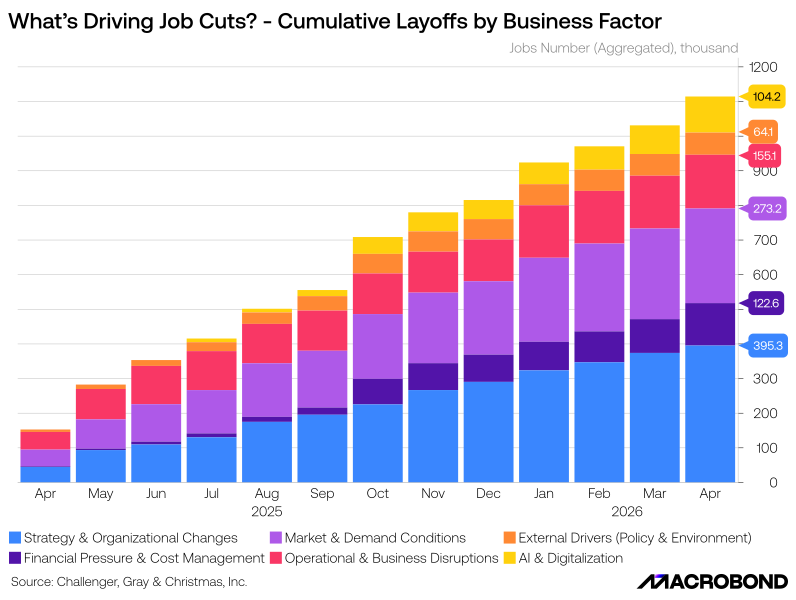
It would be difficult to ignore that AI is already contributing to job cuts. A number of corporate layoffs in recent months have been at least partly linked to its adoption, as firms look to streamline operations and reduce costs through automation.
Even with limited data - available only since roughly April 2025 - AI accounts for close to one in ten recorded job reductions. That is a meaningful and rising share. At the same time, the broader context matters: the remaining 90% of layoffs continue to be driven by more traditional factors, including cost pressures, restructuring and cyclical slowdowns.
This balance is important. It indicates that the current wave of layoffs cannot be explained by technology alone. Instead, AI is interacting with existing pressures - amplifying some, accelerating others, but not replacing them entirely.
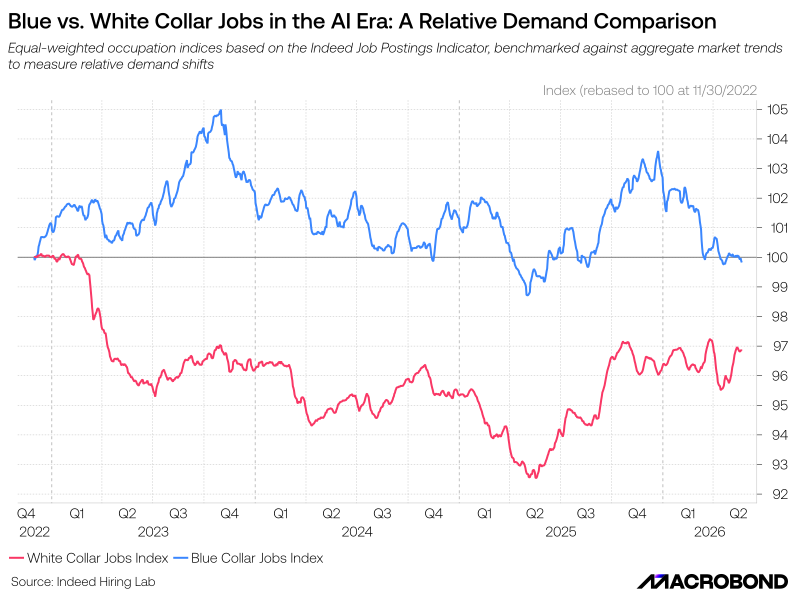
However, it is one thing to look at these shifts in detail at the sector level and another to step back and consider the broader picture, where the distinction between white-collar and blue-collar work becomes particularly relevant.
White-collar roles - those typically performed in offices - are often seen as the most exposed to AI. Using data from Indeed, we constructed a simple proxy to track demand across these two groups. The results point to a clear divergence. Since the release of ChatGPT, demand for white-collar roles has moved into decline, while blue-collar jobs have shown greater resilience.
This contrast is not entirely surprising. Many white-collar occupations are built around routine cognitive tasks, which AI is increasingly capable of augmenting or automating. By comparison, blue-collar roles tend to rely more on physical activity, on-site presence and context-specific decision-making - areas where AI’s reach remains more limited.
There are, of course, limitations to this approach. Ideally, such indices would be weighted to better reflect the true composition of the labor market, rather than treating all roles equally. Even so, as a directional signal, the divergence remains difficult to ignore.

Perhaps an even more important question is how AI is affecting youth employment. Much of the concern from researchers and policymakers centers on a simple risk: if entry-level tasks are automated, the first step on the career ladder may begin to disappear.
The logic is hard to ignore. Junior roles have traditionally served as the foundation for skill development - providing a pathway from basic tasks to more complex responsibilities over time. If those initial functions are absorbed by AI, the “pipeline” itself may weaken. Fewer junior positions today could translate into a shortage of experienced specialists in the years ahead.
This is, however, a sensitive and still unresolved issue. Evidence remains limited, and data from any single country is not sufficient to draw firm conclusions. Labor market dynamics are shaped by a range of factors, making it difficult to isolate the specific impact of AI.
At the broader European level, two parallel trends stand out. The role of AI in economic activity has been expanding steadily since 2022 across most countries. At the same time, youth unemployment has also increased in many of them. The correlation is notable, but it should be treated with caution.
Drawing a direct causal link between AI and rising youth unemployment would be too simplistic. The current economic environment - marked by slower growth, tighter financial conditions and geopolitical pressures - remains a key driver of labor market developments.
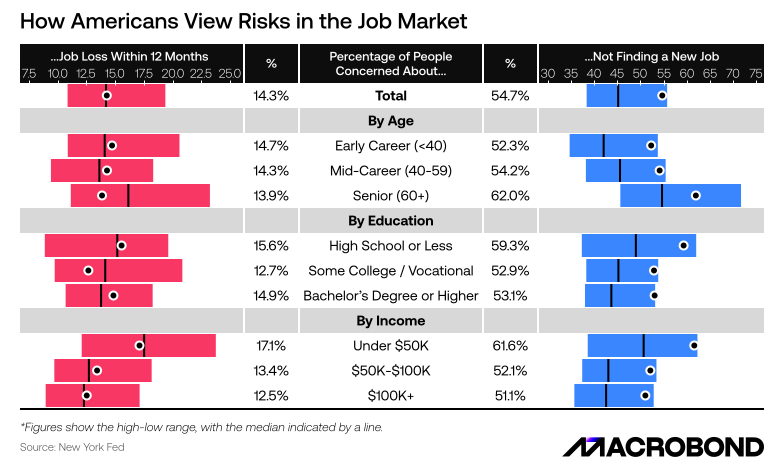
As the impact of AI on the labor market becomes more visible - but not yet fully defined - worker sentiment reflects a similar mix of stability and uncertainty.
On the surface, not much seems to have changed. Surveys show that fear of losing a job in the United States in the near term is still broadly in line with historical norms. Across age groups, income levels and education, people don’t seem significantly more worried about being laid off than they used to be.
The real concern lies further ahead. It’s not so much about losing a job - it’s about what happens next. More and more, people are worried they won’t be able to find a new one.
And here the shift is clear. Across almost all groups, concern about future job prospects is close to the highest levels we’ve seen. That contrast is telling. People feel relatively stable where they are, but much less confident about their ability to move forward.
That’s where the unease comes from. Not immediate disruption, but growing uncertainty about the path ahead. In a way, it captures the moment quite well. The labor market hasn’t fully changed yet - but expectations already have.

One key question remains - and it is about the future. Not whether AI has one. That is no longer in doubt. The real uncertainty lies in where it will take hold, how it will be used and how quickly adoption will spread.
Intuitively, we assume that some industries are already deep into AI, while others are still on the sidelines. The data does confirm that divide. In the information sector, for example, nearly half of businesses report that they expect to use AI in the near term - a signal of how deeply embedded the technology has already become.
What is more striking, however, is not just the pace of adoption, but the persistence of hesitation - even in sectors most closely associated with AI. In industries such as software, finance and media, where the discussion around AI is already well developed, roughly one-third of firms still do not expect to adopt it within the next six months.
That gap between expectations and reality is telling. AI is spreading quickly, but not evenly. Some sectors are moving decisively, others more cautiously - and even within the most forward-looking industries, uncertainty has not fully faded.


