

Global Markets, Leadership & Competition - Everything That Moves the Global Economy and Your Portfolio

For most of the past decade, investors hardly needed to think twice. If you wanted to own the world's strongest equity market, you bought America.
U.S. stocks consistently outperformed international peers, attracted unprecedented amounts of global capital and became the benchmark against which every other market was measured. "U.S. exceptionalism" evolved from a market narrative into a widely accepted investment reality.
Then in 2025, for the first time in years, the rest of the world began to pull ahead. International equities outperformed U.S. markets by a meaningful margin, prompting investors to question whether the era of American dominance was finally coming to an end. Was the world merely catching up after years of underperformance, or was something more fundamental beginning to change?
Recent market moves have only made that question harder to answer. U.S. equities have recovered much of the lost ground in 2026, yet many of the advantages that once set America apart have started to narrow. The performance gap has compressed. Risk-adjusted leadership has weakened. And international markets have become increasingly competitive.
So is U.S. exceptionalism fading?
To answer that question, we look beyond headline returns and examine six different dimensions of market leadership - from performance and risk-adjusted returns to sector drivers, global rankings and market regimes. The picture that emerges is more nuanced than either the optimists or pessimists would suggest: America's lead is no longer as overwhelming as it once was, but reports of its demise may still be premature.

For much of the past decade, U.S. equities didn't just rise - they rose faster than almost everyone else. That leadership came under pressure in 2025, when international markets began outperforming by a wide margin. At the peak, the gap reached nearly twenty percentage points, fueling speculation that the era of U.S. exceptionalism might be coming to an end.
The underperformance was notable not only because U.S. stocks came under pressure following the tariff announcements in April 2025, but also because the rest of the world was doing better. For the first time in years, investors had a credible alternative to the "buy America" trade.
Yet the picture shifted again in 2026. As market sentiment improved following a stabilization in the Middle East, U.S. equities regained much of the lost ground, narrowing the performance gap to near zero by the end of June.
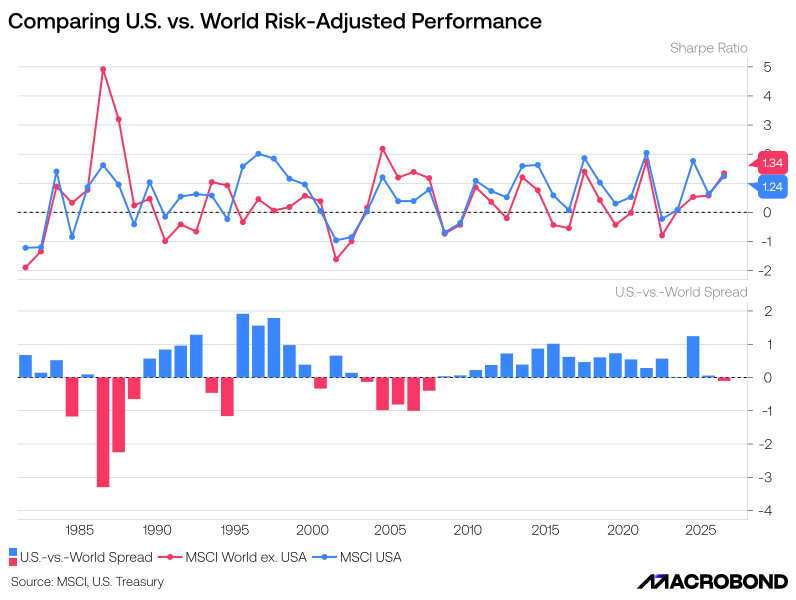
Returns alone rarely tell the full story. Investors care not only about how much a market earns, but how much risk it takes to get there.
By that measure, the case for U.S. exceptionalism remains remarkably strong. Since the Global Financial Crisis, American equities have consistently delivered superior risk-adjusted returns than global markets, generating more return per unit of volatility. In other words, investors were not just rewarded with higher returns - they were rewarded more efficiently.
That advantage helps explain why global capital has flowed so heavily into U.S. equities over the past decade. Yet the gap is no longer as wide as it once was. Over the last two years, international markets have steadily improved their risk-adjusted performance, narrowing one of the key pillars of America's long-standing market leadership.

Recent performance tells only part of the story. A tougher test is to compare the United States not with a global index, but with individual equity markets around the world.
Looking across 75 major countries since the 1970s, U.S. equities have outperformed the majority of them over the long run. That may sound modest at first glance, but the comparison spans vastly different market environments - from emerging-market growth miracles and commodity booms to technology- and AI-led rallies.
Maintaining an edge over the majority of global markets for several decades is a rare achievement. It suggests that America's leadership has been driven by more than favorable cycles alone. While periods of outperformance and underperformance come and go, the long-term record points to structural advantages that have repeatedly translated into superior equity returns.
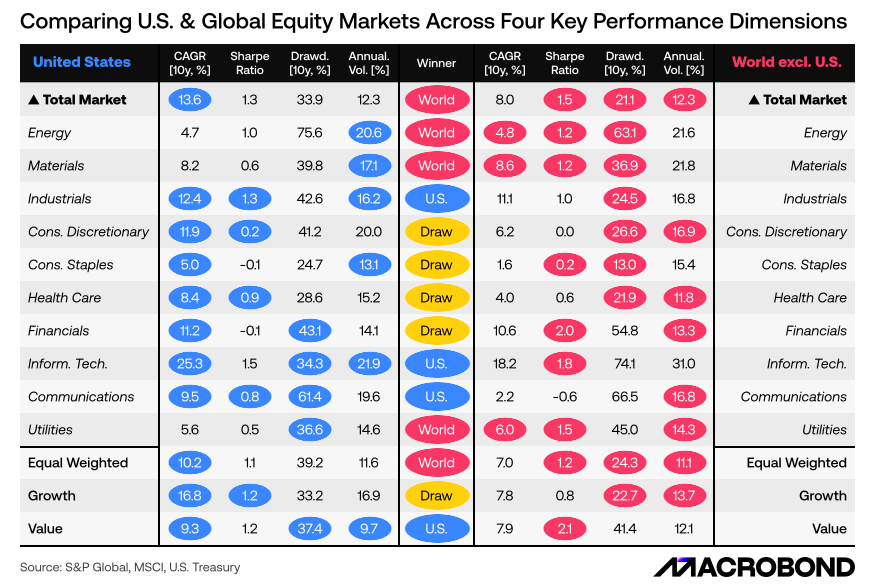
If the gap between U.S. and international markets has narrowed, the reasons matter as much as the result.
At the index level, global equities have recently gained ground thanks largely to strength in energy and materials. Higher commodity prices and renewed concerns over supply disruptions following tensions in the Middle East provided a tailwind for many resource-heavy markets.
The U.S. story looks very different. American leadership remains concentrated in information technology and communication services, where investor enthusiasm surrounding artificial intelligence, digital infrastructure and productivity-enhancing technologies continues to support earnings expectations.
The contrast is important. Recent international outperformance has been driven largely by cyclical forces, while U.S. strength continues to be anchored in innovation-led sectors. The narrowing performance gap therefore reflects not just a shift in market leadership, but a competition between two very different growth models.
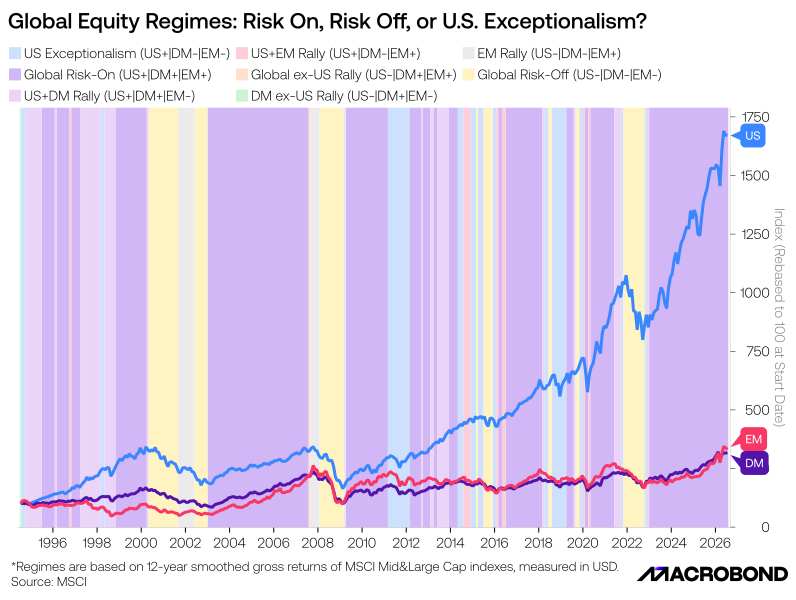
One lesson from the past few decades is that market leadership is rarely permanent. Different economic environments tend to favor different regions, creating recurring patterns in global equity performance.
The most common regime is also the most intuitive: periods when U.S., developed and emerging markets all rise together. These broad "risk-on" environments typically coincide with improving growth prospects, supportive financial conditions and stronger investor confidence.
By contrast, episodes of pure U.S. leadership - when American equities outperform while much of the rest of the world struggles - have been relatively rare. They tend to emerge when the United States benefits from a distinct cyclical or structural advantage, such as the technology-driven rally that gathered momentum in late 2024.
This suggests that U.S. exceptionalism is best viewed not as a permanent state, but as one of several recurring market regimes. The question then becomes: which of these regimes has historically delivered the strongest returns for investors?
.svg)
One might expect periods of pure U.S. leadership to deliver the strongest returns. History suggests otherwise.
Across different market regimes, American equities have generated their highest average returns during broad global rallies - periods when developed and emerging markets were rising alongside them. In other words, the best environment for U.S. stocks has not been one of global weakness, but one of global strength.
At first glance, that may seem counterintuitive. If the United States enjoys structural advantages, shouldn't it benefit most when the rest of the world struggles?
The data suggests the opposite. Strong global growth supports trade, investment and corporate spending, creating an environment in which many U.S. companies can expand earnings both at home and abroad. Rather than competing with American leadership, global prosperity has often reinforced it.
That may be the ultimate paradox of U.S. exceptionalism - America's success has rarely depended on the rest of the world lagging behind. On the contrary, the strongest market outcomes have historically emerged when U.S. leadership and global growth moved hand in hand. The world catching up does not mean America is being left behind - it may be one of the conditions that helps sustain it.


