

Memory, Markets & Misperceptions - Everything That Moves the Global Economy & Your Portfolio

For decades, South Korea fit neatly into investors' emerging-market playbook. It was viewed as a cyclical, export-driven powerhouse, highly sensitive to global trade, manufacturing cycles and shifts in risk appetite across emerging markets. When the world economy accelerated, Korea often outperformed. When growth slowed, the market typically came under pressure just as quickly.
Today, however, that description looks increasingly incomplete.
Over the past decade, semiconductors have reshaped both the economy and the stock market. Memory chips have become one of Korea's most important exports, while Samsung Electronics and SK Hynix have emerged as critical suppliers to the technologies underpinning the current AI boom. As a result, the country's market is increasingly influenced by forces that extend well beyond the traditional emerging-market narrative.
Yet perceptions have not fully caught up with reality. Korea is still widely grouped with emerging markets, even as investors show growing willingness to treat it differently from much of the asset class.
Is Korea still an emerging-market proxy, or has it become something closer to a leveraged play on the global technology cycle? In this edition of Macro Moves, we examine how investors are positioning in Korea, what is driving market behavior and whether the market's evolving identity is fully reflected in valuations.
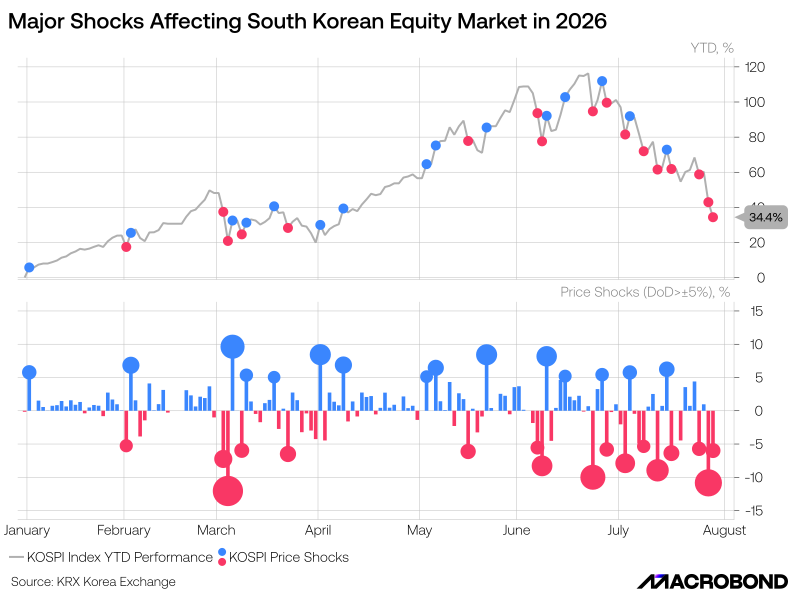
South Korean equities have had little respite from headline risk this year. After rising by as much as 120% at one point, gains have since shrunk to roughly 30% at the time of writing. Fluctuations in semiconductor demand, trade-related uncertainty, concerns about global growth and geopolitical developments have all contributed to sharp sell-offs and rebounds. Individually, none of these shocks is unique to Korea. Taken together, however, they reinforce the country's reputation as one of the world's most externally exposed equity markets.
That sensitivity is hardly surprising. As one of the world's most trade-dependent economies and a critical link in the global technology supply chain, Korea has long been an indicator of changes in international demand. The country tends to benefit disproportionately when global growth strengthens, but it also feels the effects of uncertainty faster than most when conditions deteriorate.
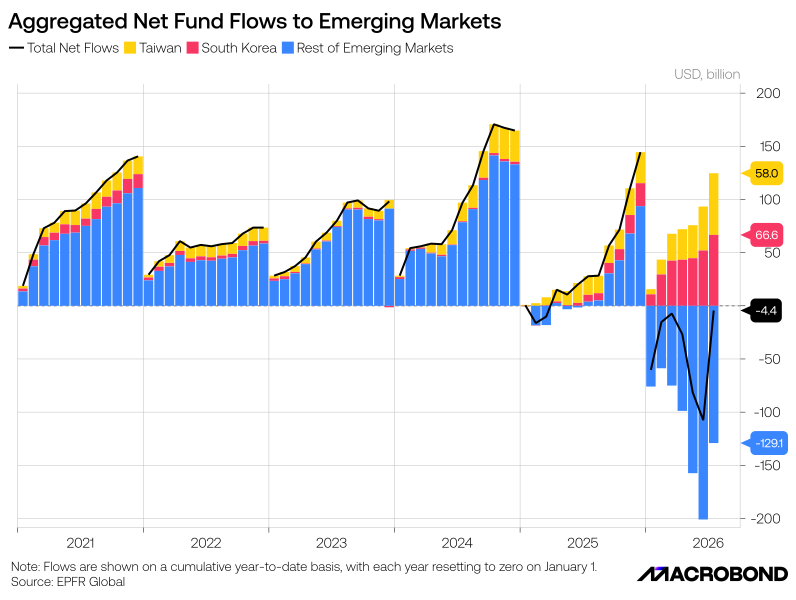
On paper, South Korea seems an unlikely refuge in an uncertain world. Few markets are as exposed to shifts in global trade, semiconductor cycles and geopolitical tensions. Yet investors have continued to pour money into South Korean equities even as capital has flowed out of much of the emerging-market universe.
This counterintuitive trend reflects a growing divide within emerging markets. Investors are no longer allocating capital based solely on traditional EM characteristics such as macro-growth or commodity exposure. Instead, they are increasingly seeking exposure to a handful of structural themes capable of transcending a volatile macroeconomic backdrop.
Korea has emerged as one of the clearest beneficiaries of that shift. Sitting at the heart of the global semiconductor supply chain, the country offers direct exposure to one of the defining investment themes of recent years: the AI infrastructure buildout. As technology companies race to expand computing capacity, demand for high-performance memory chips has surged, placing Korean chipmakers at the center of one of the decade's most powerful investment stories.
That strategic positioning has begun to change how the Korean market is perceived. While many emerging economies have struggled to attract capital amid rising geopolitical tensions and a challenging global environment, Korea and Taiwan have remained magnets for investor flows. In both cases, the appeal lies less in their emerging-market status than in their critical role within the technologies driving global growth.
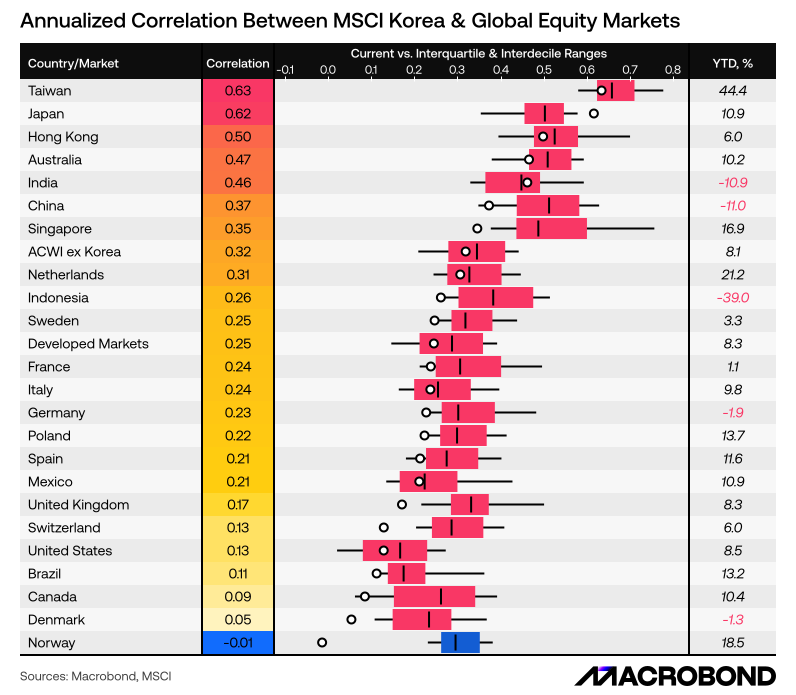
Markets rarely change their identity overnight. But if Korea is increasingly being viewed through the lens of AI and semiconductors rather than as a classic export-driven economy (i.e., a conventional emerging market), traces of that shift should be visible in how closely it moves with the rest of the world.
Of course, Korea's strongest relationship remains with Taiwan, reflecting the two markets' shared dependence on semiconductors and global technology demand. More revealing, however, is the extent to which Korea's connections with most other equity markets have weakened.
Correlations with both developed and emerging markets have drifted toward the lower end of their historical ranges, suggesting that South Korean equities are becoming less synchronized with broader market trends than they once were.
Japan is one of the few exceptions among developed markets. But beyond that, Korea appears to be charting its own course, with market performance increasingly shaped by developments in the semiconductor and memory-chip industry rather than broad macroeconomic trends.
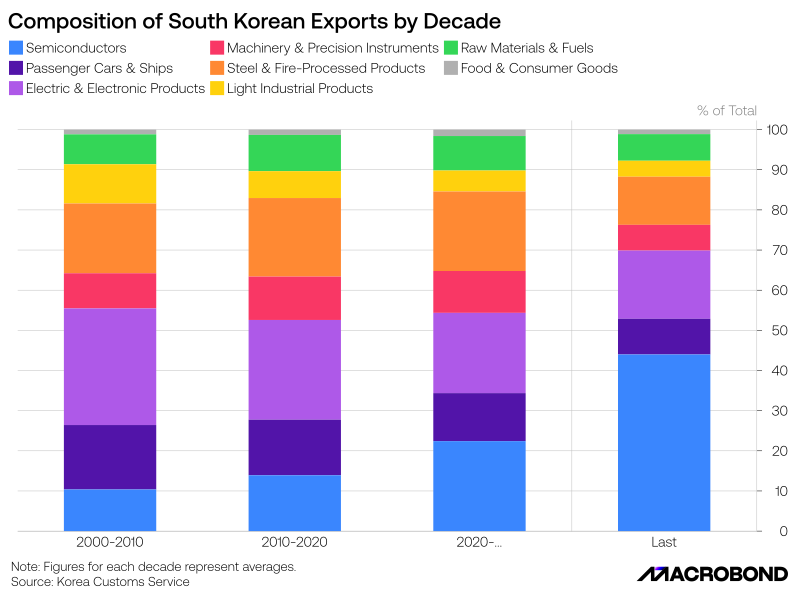
Korea's growing independence from broader market trends did not happen by accident. It is the result of a profound transformation in the country's export engine. Over the past two decades, semiconductors have moved from being just one part of Korea's export mix to becoming one of its defining industries, reshaping both the economy and the equity market in the process.
The shift has been gradual but decisive. While Korea remains a diversified exporter, an increasing share of its fortunes is tied to high-value technology products. Memory chips, in particular, have become central to the country's export story, reflecting the global dominance of Samsung Electronics and SK Hynix. Together, the two companies account for a substantial share of global memory production, leaving Korea uniquely positioned to benefit from the surge in demand driven by artificial intelligence.
The implications extend far beyond trade statistics. As semiconductors have gained importance, Korea's exposure to the global economy has evolved as well. The country is no longer simply exporting cars, ships and consumer electronics to the world. Increasingly, it supplies critical components that sit at the foundation of the digital economy, from data centers to AI infrastructure.
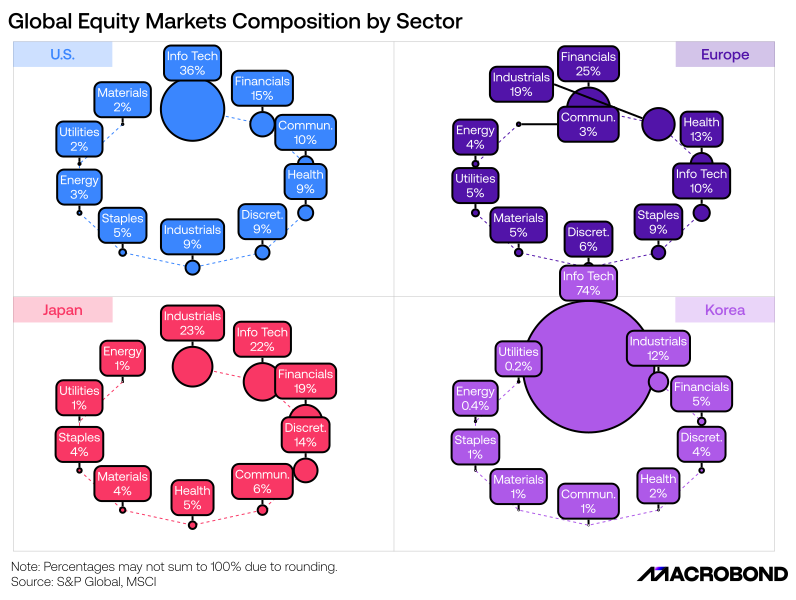
The transformation of Korea's export base is perhaps most visible in its equity market. Technology companies now account for more than 70% of market capitalization, making Korea one of the most sector-concentrated major equity markets in the world.
Few major equity markets are as heavily concentrated in a single sector as Korea. Investors have spent years debating the growing influence of large technology companies in markets such as the United States, yet few major markets are as dependent on a single sector as Korea. To a significant extent, the South Korean stock market has become less a reflection of the broader economy and more a direct expression of the global semiconductor cycle.
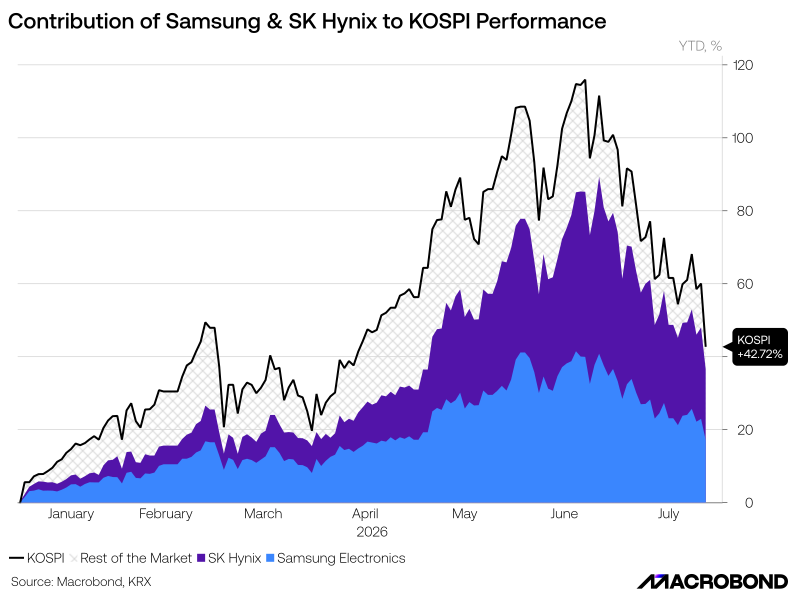
Yet the concentration of the South Korean market is not merely a sector story. Increasingly, it comes down to just two companies.
Over recent years, an outsized share of KOSPI performance has been driven by just two names: Samsung Electronics and SK Hynix. Together, the two companies dominate the global memory-chip industry and have emerged among the biggest beneficiaries of the rapid expansion in AI infrastructure spending.
In that sense, Korea's equity market increasingly resembles the U.S. experience with the Magnificent Seven, albeit in a far more concentrated form. While U.S. market leadership is spread across multiple technology giants, Korea's performance is increasingly tied to the fortunes of a semiconductor duopoly.
This concentration helps explain much of the market's recent behavior. When investors become more optimistic about AI spending, data-center buildouts or memory demand, Korea can outperform dramatically. When sentiment toward the technology cycle weakens, the reverse is often true.
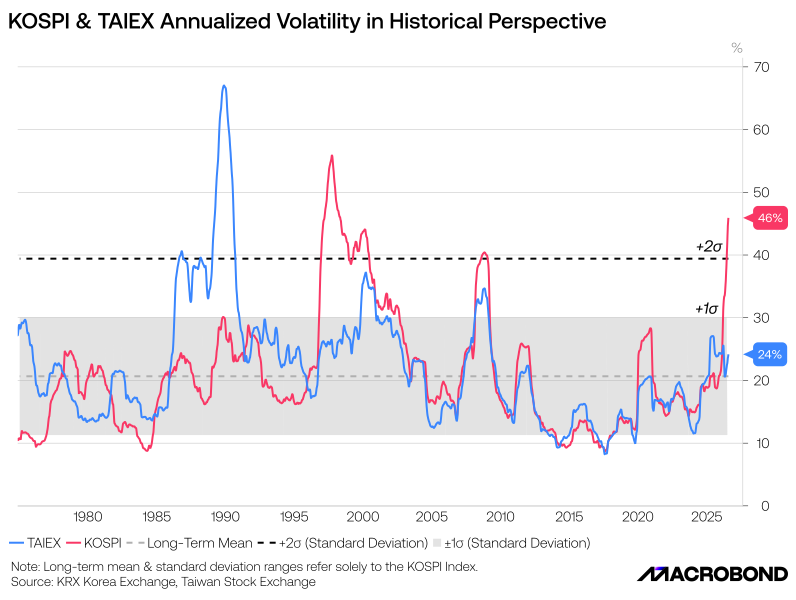
Korea's concentration comes with a clear trade-off. The same market structure that allows investors to gain highly targeted exposure to semiconductors and artificial intelligence also leaves the market unusually sensitive to shifts in the technology cycle.
As the influence of Samsung Electronics and SK Hynix has grown, so too has Korea's exposure to fluctuations in memory-chip demand, AI-related investment spending and broader technology sentiment. Periods of optimism can propel the market sharply higher. But when expectations begin to soften, those same forces can work in reverse.
This helps explain why South Korean equities continue to exhibit higher volatility than many global markets, even Taiwan’s. The same characteristics that allow the market to benefit disproportionately from periods of strong AI and semiconductor demand can also amplify downside risks when investor expectations shift.
Unlike more diversified markets, Korea has fewer sectors capable of offsetting weakness in technology-related industries. As a result, changes in memory prices, AI-related investment spending or semiconductor inventories can quickly echo across the broader market.
For investors, this volatility is both a risk and a defining feature of the South Korean equity story. The market's growing dependence on a handful of globally dominant companies creates significant upside potential, but it also helps explain why Korea continues to trade with a persistent risk premium.
.svg)
For much of its history, valuations reflected what Korea was: an export-driven economy exposed to the ups and downs of global trade. Investors recognized the country's industrial strengths, but concerns over geopolitics, export dependence and market concentration often limited the premium they were willing to pay for future growth.
That relationship may be starting to change. Traditional valuation measures suggest South Korean equities remain broadly in line with their historical norms. Yet a different picture emerges when earnings are viewed through a longer-term lens. Our alternative CAPE-style measure has climbed to levels that would have seemed difficult to imagine only a few years ago.
The gap reflects a market caught between two competing narratives. On one side are the familiar risks that have long defined the Korean investment story. On the other is a growing belief that the country occupies a uniquely valuable position in the global AI and semiconductor ecosystem.
Investors appear increasingly willing to look beyond Korea's traditional vulnerabilities and focus instead on the opportunities created by rising demand for memory chips, AI infrastructure and advanced semiconductors. In doing so, they are assigning greater value to earnings that only recently would have been viewed as highly cyclical.
Korea may still be classified as an emerging market, but the market increasingly trades as a proxy for something else - the global race to build the infrastructure behind artificial intelligence.


