

The BOJ’s move to 1.25% puts yen-driven inflation at the center of policy, with implications for rates, currency markets and Japanese corporate earnings.


The Bank of Japan’s September move to 1.25% was not a routine adjustment but a genuine policy regime change, driven by rising risks of yen‑driven inflation, reinforced by geopolitical currency coordination and other external factors. While structural forces still point toward a weaker yen, the BOJ’s shift—and the threat of the so‑called “Bessent Cannon”—should limit extreme downside, preserving a supportive backdrop for Japanese corporate earnings.
Investor takeaways:
Governor Ueda described the hike as a response to a “regime change,” echoing Board Member Takata’s earlier remarks. Takata argued that the global tightening bias in 2026 marks a break from the “unusually eventful easing cycle of 2024–25,” and warned that neutral‑rate estimates based on Lost Decade data are outdated. He also questioned the assumption of steady 25bp hikes every 6 months, suggesting the possibility of faster or larger moves.
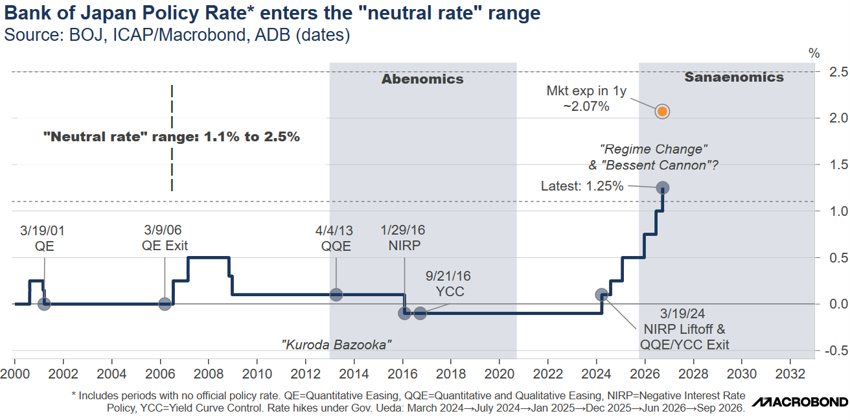
Ueda’s definition was inflation‑centric: trend inflation,once believed to be below 2%, is now effectively at 2%. With external price pressures combining with stronger corporate pricing power and wage growth, the BOJ’s mission must shift from achieving 2% inflation to sustaining it, he stressed. Markets currently expect roughly three more hikes over the next year toward ~2%, near the midpoint of the BOJ’s neutral‑rate range(1.1–2.5%), as this graph shows.
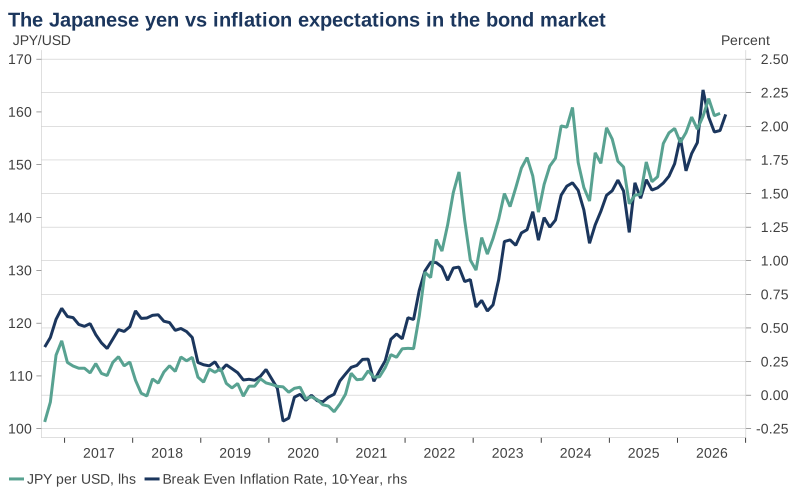
The policy stance appears to have shifted: greater weight is now placed on the upside risks to inflation. At the September meeting, as in July, the BOJ highlighted three inflation risks: Middle East tensions, AI-driven demand, and yen-driven import costs. However, markets remain focused on the yen. As the following graph implies, a weakening yen generally drives inflation expectations higher. This dynamic is now amplified by AI‑related demand, renewed oil pressure, and strong wage growth. The implication for investors: the yen has de facto become a primary input into BOJ policy, not merely an outcome of rate differentials.
The geopolitical backdrop surrounding the hike was noteworthy. Japan’s top currency diplomat described the July joint intervention as “the final stage of a US‑Japan currency union,” and officials acknowledge that faster BOJ tightening was a US condition for the coordinated action. The BOJ also “abruptly added” yen weakness as an inflation risk in the July Outlook Report to signal hawkishness when back‑to‑back hikes were “not feasible.”
The BOJ’s split decision versus the Fed’s unanimous hike left the policy‑rate differential unchanged—offering the yen no support and reinforcing the need for a more assertive stance going forward. Meanwhile, dissents from PM Takaichi’s two dovish appointees pointed to stiffer resistance ahead – next July, two hawks get replaced, probably with two Takaichi doves. The dissents reinforced perceptions that hikes could get pulled forward: it is widely believed that Takaichi opposes hikes that could undermine Sanaenomics, her investment-led growth strategy and a political campaign promise.
The hike was preceded by weeks of Bessent’s warnings to yen shorts — eg. “I am the House now… bet against me if you want” and calls for a stronger BOJ. FX traders and strategists report that this “Bessent Cannon” has cooled bearish sentiment, with some capitulating and others eyeing 150 as a key loss‑cut level. FX margin trading volume has declined, confirming the sentiment.
Still, strong structural forces remain that keep the yen from strengthening: eg. wide rate differentials, overseas earnings reinvested abroad, automated NISA flows, and a widening “digital trade deficit” (ie. fees to US tech giants) that offsets Japan’s headline current‑account surplus. Adjusting for Japanese cashflows, the surplus flips to a deficit, implying yen weakness.
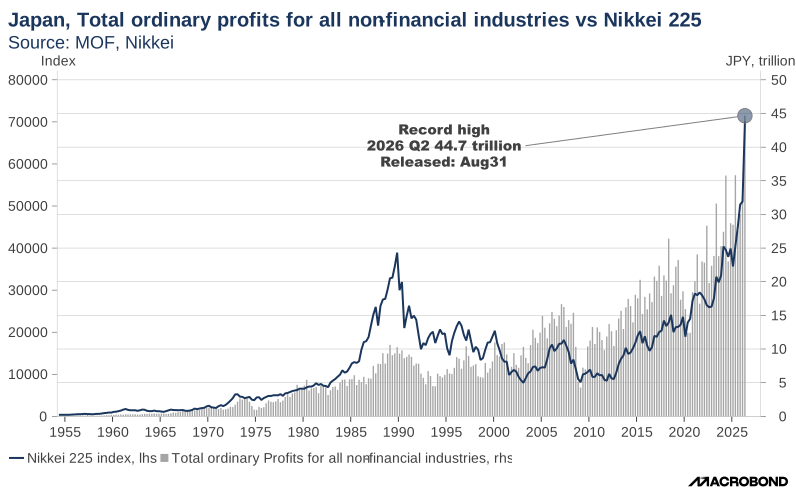
Despite five hikes since 2024, Japanese corporate profits remain at record highs. The weak yen and the lift to nominal earnings from yen-driven inflation have helped (see Japan’s Inflation Revolution). Along with the structural forces mentioned above, the outlooks for US-Japan rate and growth differentials and Japan’s energy-sensitive trade balance point to a weaker yen. Yet the BOJ’s regime change and fears of the “Bessent Cannon” may cap extreme yen weakness without reversing it—maintaining a fine balance that supports profits and equities while forcing policymakers to lean against inflation.
Related links on JPX JoinMall:


