

With inflation rising and financial conditions continuing to ease, Michael Kramer examines why the Federal Reserve may need to raise interest rates at its September 16 meeting.


The FOMC meeting on September 16 is probably the Fed’s last chance to raise rates until December, especially since the midterm election lands just days after the Fed’s October 28 meeting. Whether it raises rates or not, the Fed has fallen behind the inflation curve and has allowed policy to not only loosen but also, by some measures, become accommodative. At this point, the Fed risks compounding its error by failing to act.
Central banks globally have been raising rates, with the ECB, Bank of Japan, and Bank of Korea already having raised at least once this year, while the Reserve Bank of Australia and the Bank of Canada may be next to follow, as the FOMC drags its feet. To compensate, U.S. Treasury rates have surged as markets reprice policy in response to the Fed’s lack of progress.
During the 2022 tightening cycle, it was noted more than once that monetary policy was transmitted through financial conditions. If that still holds true, the Fed has allowed broad financial conditions to ease without providing enough offsetting restraint.
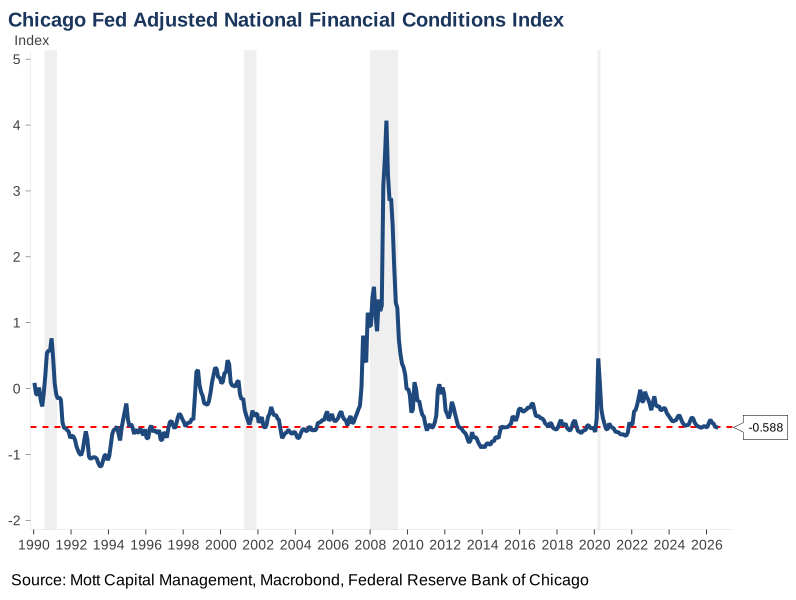
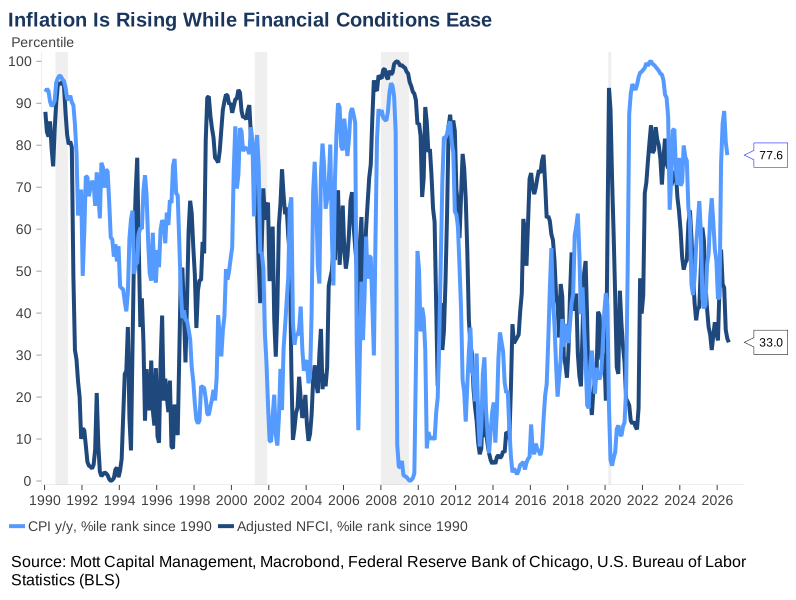
The Chicago Fed’s Adjusted National Financial Conditions Index accounts for economic activity and inflation, showing how tight or loose financial conditions are relative to the economic backdrop. The latest data show it is currently around its 34th percentile of readings since 1990, while year-over-year CPI is at the 78th percentile over the same period. Simply put, financial conditions have been looser only about a third of the time in more than 30 years, and most of those episodes came with inflation falling, not rising. Currently, the Fed is making the same error it made in 2021 by responding late to the rise in inflation.
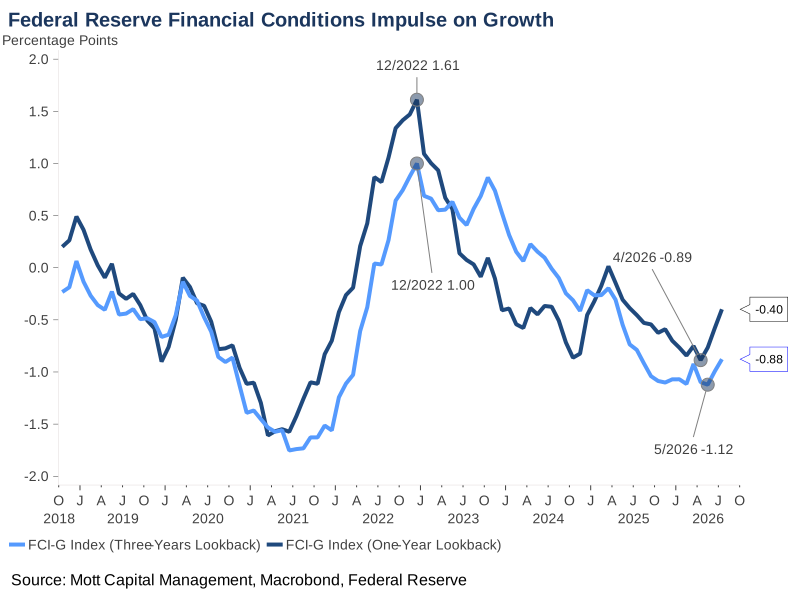
Other measures of financial conditions have eased considerably over the same period. The Fed's financial conditions impulse on growth index, which estimates how much financial conditions add to or subtract from GDP growth, peaked in December 2022. Since then, the 3-year lookback has fallen from about 1.0 to -0.88, while the 1-year lookback fell from a peak of 1.6 in December 2022 to about -0.9 in May 2026 before rebounding to -0.40 in July. A negative reading indicates that conditions are supporting growth, and the magnitude of the swing shows that conditions shifted from a drag of roughly a point on growth to a tailwind of about the same size.
Measured from that peak, the easing since late 2022 ranks among the largest since 1982, with the 1-year lookback falling about 2.5 points below its prior high at the May trough. The only periods that saw more easing were 1983, 1986, and 2010. What is more interesting is that easing seen in 1983 and 2010 followed economic recessions. This one did not.
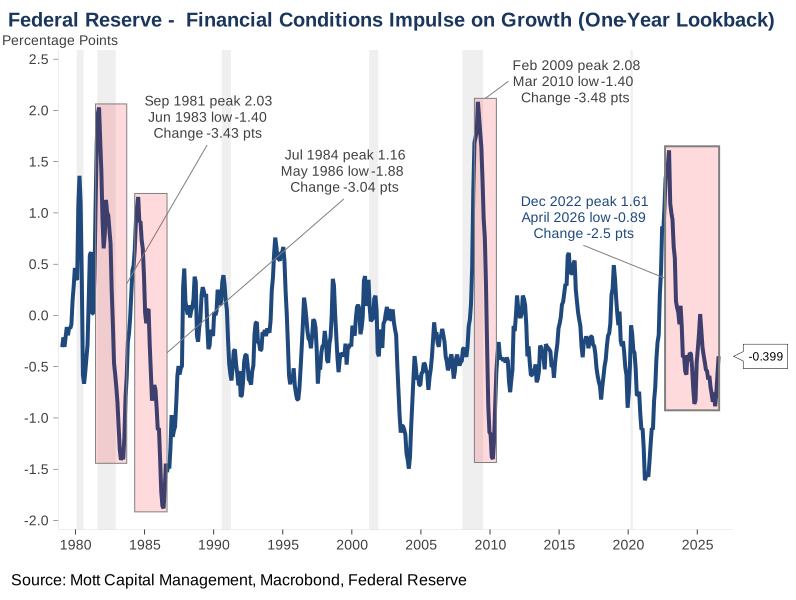
The data appears to show that broad financial-condition measures examined here provide little evidence of meaningful restraint; in fact, the data shows the easing of conditions has been among the largest in the past 40 years. It is likely why Chair Kevin Warsh mentioned financial conditions in his Jackson Hole speech, noting that he would be hard-pressed to describe broad financial conditions as restrictive.
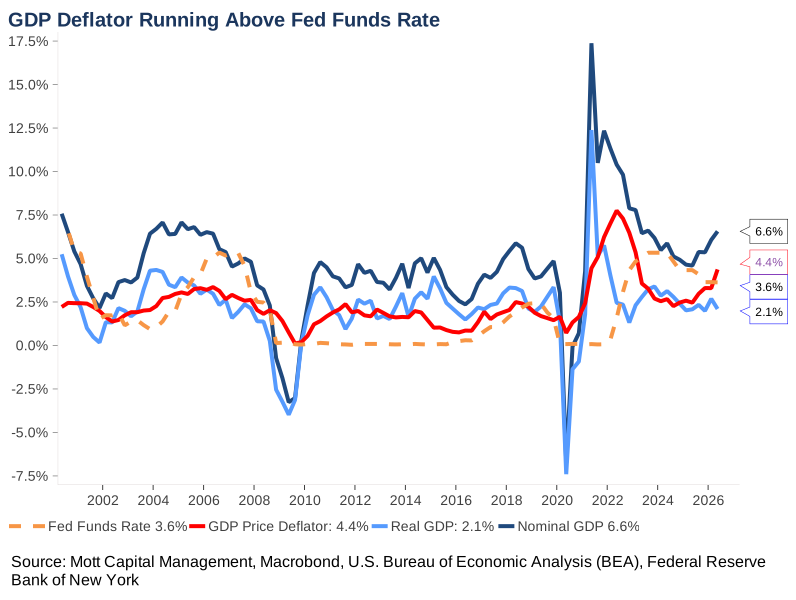
It leaves one wondering how the Fed can bring inflation back to target if financial conditions are not restrictive enough and supportive of the economy and growth. The data shows that nominal GDP growth rose to 6.6% year-over-year, while the GDP price deflator rose to 4.4%, and real growth has held near 2%. The acceleration in nominal GDP is entirely inflation.
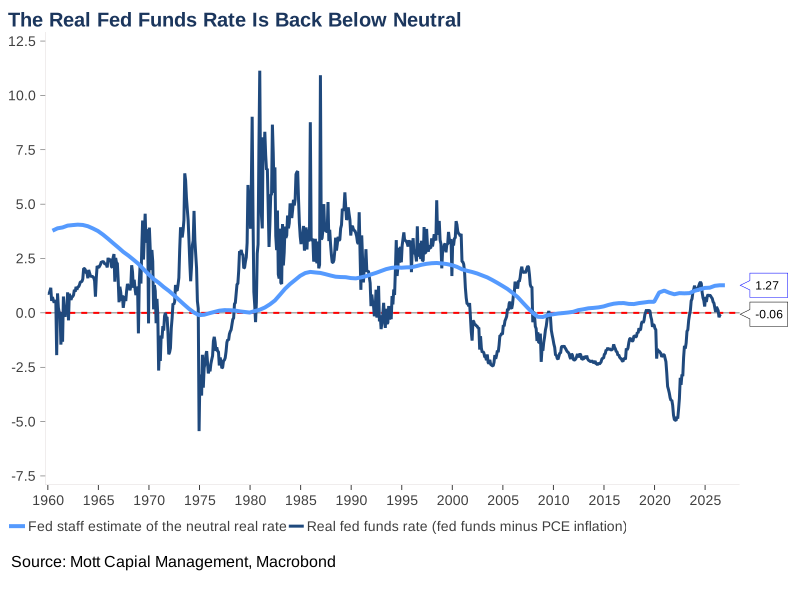
On top of that, the Fed Funds rate is negative relative to the July headline PCE reading. Oddly, since the 2001 recession, the Fed Funds rate has often been below the PCE rate, including after the financial crisis of 2008-2009. However, there has not been a recession, or, for that matter, an economic slowdown, in recent years. So, at this point, a real fed Funds rate below zero suggests that policy at the current rate is again supporting inflation. More so, the real fed funds rate is below a Fed staff estimate of the neutral real rate, about 1.3%.
One could even argue that the market sees the neutral rate as being higher than the Fed’s long-run view. The 5y5y forward real yield has risen to about 2.8%, its highest since 2009, while the 5y5y forward breakeven has stayed near 2.3%, where it has sat for four years. The real yield now exceeds expected inflation by roughly 50 basis points, something that has not happened since 2010. Nominal yields are rising because investors are demanding a higher return over and above inflation, not because they expect more of it.
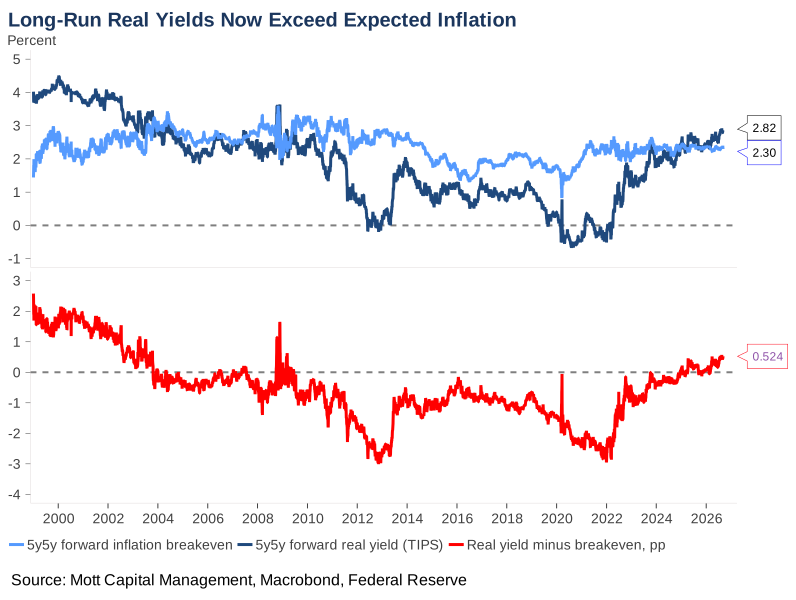
In the end, the market appears to be picking up the slack to keep inflation expectations anchored by pushing real rates higher, because policy at this juncture appears too loose and potentially accommodative for the economy.
The Fed should be raising interest rates, and at this point those hikes can’t come soon enough. Holding rates steady is likely to continue to yield the same results and not produce the tightening needed in financial conditions to bring inflation back to target.
Michael J. Kramer is the founder and CEO of Mott Capital Management, a registered investment advisor he launched in 2014, where he manages the firm's long-only Thematic Growth Portfolio and publishes daily research on equities, rates, volatility, and market positioning. He brings more than three decades of financial industry experience, beginning his career as a buy-side international and domestic equity trader at US Trust and Gilder, Gagnon, Howe & Co. His approach combines fundamental and technical analysis with a close read of options-market positioning and central bank policy. His commentary appears regularly on Seeking Alpha, MarketWatch, and across social media, and is read by institutional desks, financial journalists, and individual investors. He holds a Master of Science in Investment Management from Pace University and a Certificate in Risk Management from New York University, and is based in New York.
Disclaimer: This report contains independent commentary to be used for informational and educational purposes only. Michael Kramer is a member and investment adviser representative with Mott Capital Management. Mr. Kramer is not affiliated with this company and does not serve on the board of any related company that issued this stock. All opinions and analyses presented by Michael Kramer in this analysis or market report are solely Michael Kramer’s views. Readers should not treat any opinion, viewpoint, or prediction expressed by Michael Kramer as a specific solicitation or recommendation to buy or sell a particular security or follow a particular strategy. Michael Kramer’s analyses are based upon information and independent research that he considers reliable, but neither Michael Kramer nor Mott Capital Management guarantees its completeness or accuracy, and it should not be relied upon as such. Michael Kramer is not under any obligation to update or correct any information presented in his analyses. Mr. Kramer’s statements, guidance, and opinions are subject to change without notice. Past performance is not indicative of future results. Neither Michael Kramer nor Mott Capital Management guarantees any specific outcome or profit. You should be aware of the real risk of loss in following any strategy or investment commentary presented in this analysis. Strategies or investments discussed may fluctuate in price or value. Investments or strategies mentioned in this analysis may not be suitable for you. This material does not consider your particular investment objectives, financial situation, or needs and is not intended as a recommendation appropriate for you. You must make an independent decision regarding investments or strategies in this analysis. Before acting on information in this analysis, you should consider whether it is suitable for your circumstances and strongly consider seeking advice from your own financial or investment adviser to determine the suitability of any investment.


